Hyundai Construction announced on the 23rd that it has received safety certification for its residential PC (Precast Concrete) Ramen frame beam and column joint technology.
PC refers to a construction method where components are pre-manufactured in a factory and only assembled on-site, while Ramen frame refers to a structure that supports loads using columns and beams. The Ramen frame has no partition walls dividing the space, allowing for flexible floor plans and increased space utilization.
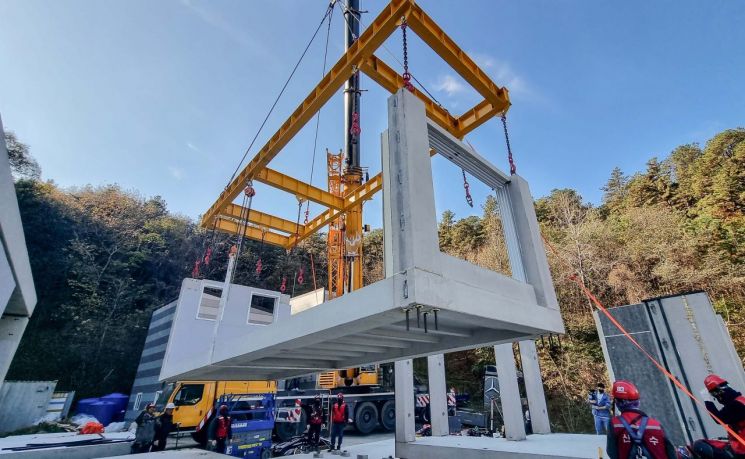 A PC frame modular prototype (mock-up) constructed within Hyundai Engineering & Construction's Yongin Technology Research Institute is being built. Photo by Hyundai Engineering & Construction
The technology for which Hyundai Construction received certification this time is a joint technology used to construct Ramen structures, rather than the commonly used wall-type structures in apartments, using off-site construction methods. Hyundai Construction developed this technology in collaboration with Camu E&C to enhance the structural safety of beam and column joints.
This company is the first to receive certification for this technology from the Korea Society of Structural Engineers. The company expects it to be widely applied in apartment construction sites in the future. A company representative stated, "We will provide residential environments that meet residents' needs, such as changes in unit size according to lifestyle and quiet apartments without noise between floors."
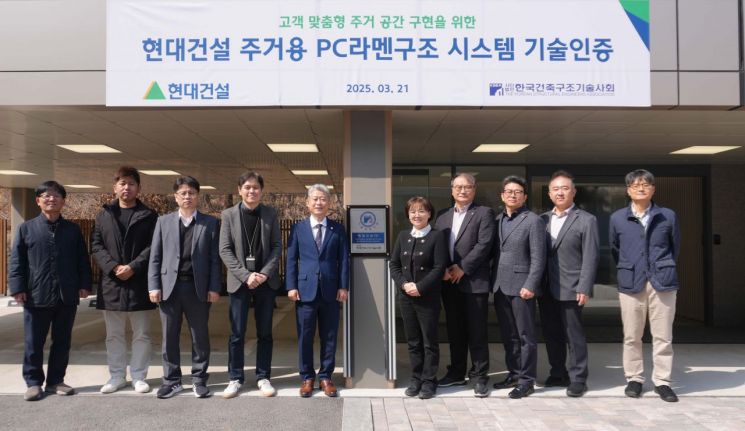 On the 21st, a plaque ceremony commemorating the technology certification was held at Hyundai Engineering & Construction's Yongin Technology Research Institute, attended by Kim Young-min, President of the Korea Society of Structural Engineers, and Ahn Gye-hyun, Executive Director of Hyundai Engineering & Construction. Photo by Hyundai Engineering & Construction
© The Asia Business Daily(www.asiae.co.kr). All rights reserved.













