190 Revolutionary Movements in 200 Years: Political Instability Fuels Economic Hardship
Escalating Protests Amid Fierce Rivalry Between Current and Former Presidents
Last Year’s Military Coup Attempt Ended in Just Three Hours
Author Yoo Si-min claimed on a YouTube broadcast that if the impeachment of President Yoon Seok-yeol is dismissed, South Korea could become like Bolivia, saying it would be no different from "giving a permit to declare martial law at any time and mobilize the military at will." Bolivia, which is facing a presidential election this August, is a country that has experienced political turmoil with 190 revolutionary movements over 200 years.
Bolivia is well known as a tourist destination. The most famous place is the Uyuni Desert, the largest salt flat in the world. Visiting during the rainy season, the rainwater covering the desert reflects the blue sky, creating a beautiful scene known as the 'world's largest mirror.' The Uyuni Desert covers an area of 10,060 km², similar in size to Gyeonggi Province (12,000 km²). Along with Peru and Chile, it is the birthplace of the ancient Inca civilization and is also well known for the Amazon rainforest, home to pink dolphins.
However, the political situation is chaotic. Since gaining independence from Spain in 1825, Bolivia has experienced 190 revolutionary movements and coups over 200 years, with political and social instability leading to economic difficulties. Despite possessing vast resources such as oil and natural gas, Bolivia's per capita gross domestic product (GDP) was only about $3,500 last year, roughly one-tenth of South Korea's (approximately $36,000).
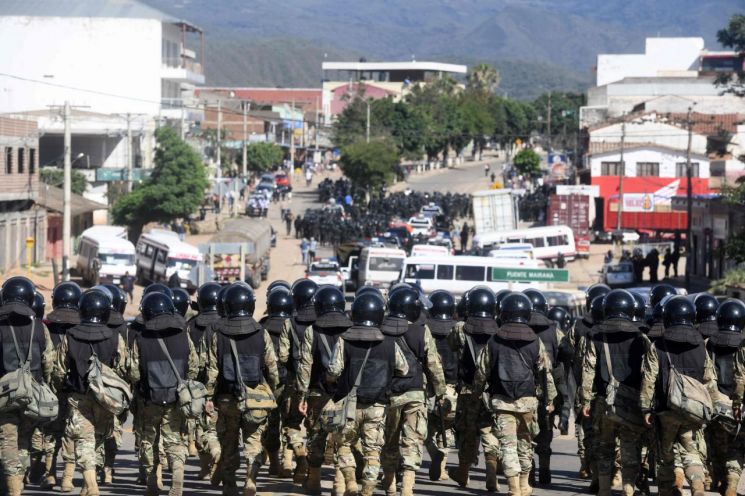 On November 4 last year, supporters of former Bolivian President Evo Morales and military police confronted each other on a road in Mairana, Santa Cruz Department, Bolivia. Photo by AFP Yonhap News
The current political rivals are the incumbent President Luis Arce and former President Evo Morales. Morales, who ruled Bolivia for 14 years from 2005 and was regarded as the first indigenous president and a successful socialist leader, was toppled amid allegations of election fraud. Morales eventually resigned and went into exile abroad, and his close ally Arce took power.
When former President Morales returned to Bolivia aiming to run again in the presidential election, the conflict with President Arce deepened. In December 2023, Bolivia's Constitutional Court ruled that Morales, who had already served three terms, was ineligible to run again, a decision Morales denounced as a plot by President Arce. In response, Morales' supporters blocked major highways for 40 days in October last year, staging protests. The roadblocks disrupted transportation of natural gas and other goods, worsening the foreign currency shortage.
The protests caused economic losses estimated at around $3 billion (approximately 4 trillion won), and major international credit rating agencies downgraded Bolivia's sovereign bonds to junk status. In January this year, Bolivia's National Institute of Statistics (INE) reported that last year's inflation rate reached 9.97%, the highest in 16 years, citing political conflicts such as Morales supporters' roadblocks as a major factor behind the price increases.
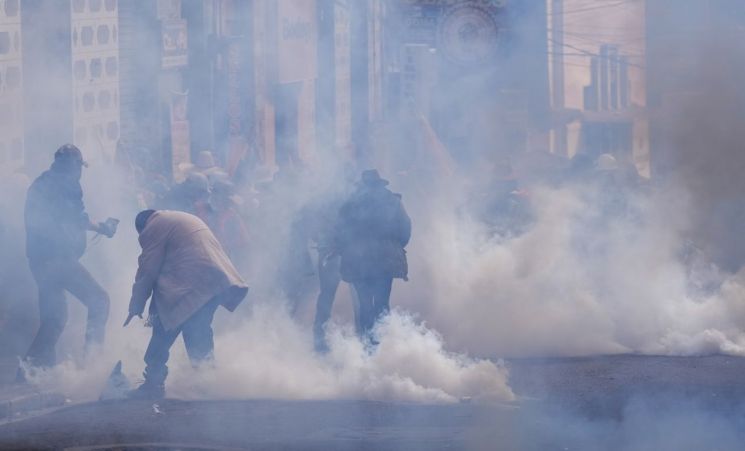 On January 13 (local time), supporters of former President Evo Morales fled after the police fired gas during an anti-government protest held in La Paz, Bolivia. Photo by AP News
In June last year, there was also a 'three-hour coup.' In June, a military unit led by former Bolivian Joint Chiefs of Staff Chairman Juan Jose Suniga occupied the capital La Paz with tanks and armored vehicles and entered the presidential palace but withdrew after about three hours. Some soldiers fired tear gas at civilians. Although the coup was ostensibly due to dissatisfaction with the current government, some suspected it might have been a staged event by the regime.
Political turmoil in Bolivia is expected to continue ahead of the presidential election this August. Last month, former President Morales announced he would run again under a different party. Although it is expected he cannot officially run due to having served three terms, Morales is aiming for a political comeback based on his strong support base. His supporters continue anti-government protests in La Paz and other areas. Currently, Morales is under investigation by prosecutors for allegedly trafficking a 15-year-old girl for sexual purposes, but he claims this investigation is also a political attack by the current government.
© The Asia Business Daily(www.asiae.co.kr). All rights reserved.












