Special Act to Support the Secondary Battery Industry Discussed at National Assembly Forum on the 21st
Establishing Legal and Institutional Foundations for Fostering the Secondary Battery Industry
Pohang, South Korea's leading battery city, has taken the initiative to enact a special law to foster and support the domestic secondary battery industry.
On the 21st, Pohang City held a National Assembly forum at the National Assembly Members' Office Building to discuss the enactment of the "Special Act on Supporting the Secondary Battery Industry."
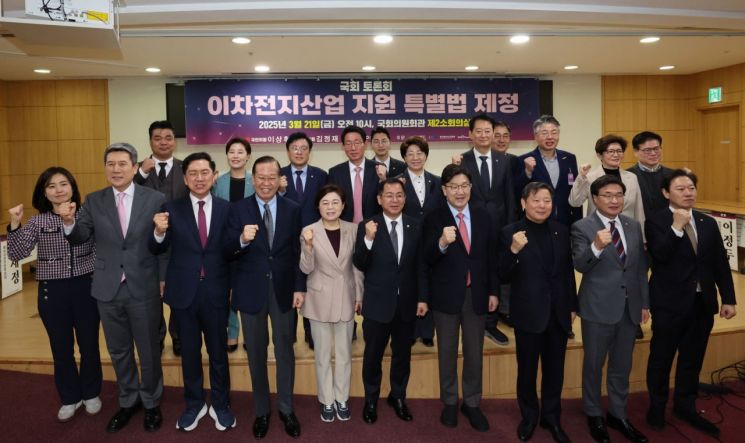 Pohang City held a National Assembly forum on the 21st at the National Assembly Members' Office Building to discuss the enactment of the "Special Act to Support the Secondary Battery Industry." Provided by Pohang City
The forum was organized by the city and co-hosted by local National Assembly members Lee Sanghui (Pohang-si Nam-gu Ulleung-gun) and Kim Jeongjae (Pohang-si Buk-gu).
Attendees included Kwon Youngse, Emergency Response Committee Chair of the People Power Party, Kwon Seongdong, Floor Leader of the People Power Party, Kim Sanghun, Policy Committee Chair of the People Power Party, Lee Cheolgyu, Chair of the National Assembly’s Industry, Trade, Energy, SMEs, and Startups Committee, as well as People Power Party members Kim Giheon and Lee Dalhee, all of whom lent their support to the enactment of the special law.
Additionally, over 100 participants, including representatives from secondary battery companies such as Ecopro and Posco Future M, research institutes, and the Ministry of Trade, Industry and Energy, attended the forum, expressing consensus on the necessity of the special law and discussing practical support measures.
At the forum, Lee Jeongdu, Secondary Battery PD at the Korea Institute for Advancement of Technology, gave a keynote presentation on global secondary battery industry trends and domestic response strategies, while Park Jaebeom, Senior Researcher at Posco Research Institute, presented on the current status of battery material companies and the need for policy support.
The subsequent panel discussion was chaired by Kim Gwangju, CEO of SNE Research, and included Park Junmo, attorney at Yulchon LLC; Park Jaejeong, Director of the Battery, Electricity, and Electronics Division at the Ministry of Industry; Park Gyuyoung, Professor of Battery Engineering at POSTECH; Jang Inwon, Head of Global Resources at Ecopro Holdings; and Han Mihyang, Head of Communications at Posco Future M. The panel discussed the necessity of the special law and various support measures for strengthening the competitiveness of the secondary battery industry through collaboration among academia, industry, research, and government.
Participants agreed that secondary batteries are a core national strategic industry and that bold government support is urgently needed to secure leadership in the global energy sector.
They also agreed that, as domestic companies are struggling due to investments in environmental facilities and rising electricity costs, a Korean version of the Inflation Reduction Act (IRA) is needed to systematically foster and support the secondary battery industry.
The secondary battery industry requires large-scale initial facility and R&D investments and has industrial characteristics that make it difficult to generate profits in the short term. Therefore, policy support and institutional improvements from the government and the National Assembly are crucial for companies to survive in the global market.
Pohang City plans to actively pursue the enactment of the special law by collecting opinions from this forum, aiming to systematically foster and support the secondary battery industry and establish legal and institutional foundations to secure leadership in the global battery market and contribute to the regional and national economy.
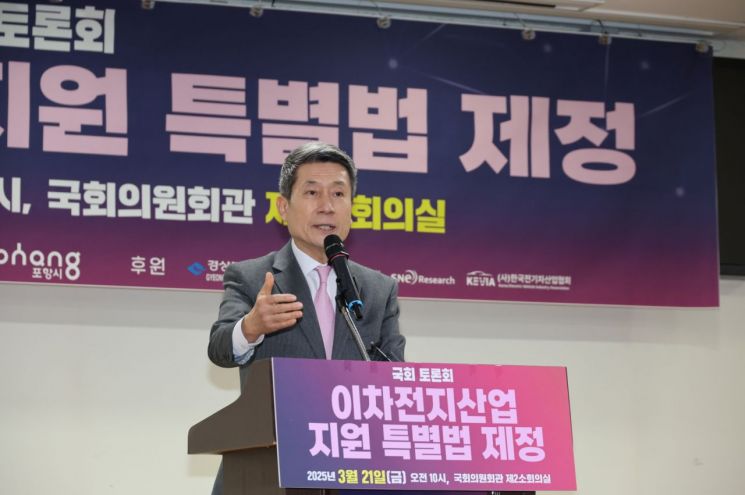
Mayor Lee Kangdeok said, "I hope this forum will be the starting point for the enactment of a special law to provide comprehensive support for the secondary battery industry," adding, "Based on the special law, I urge the National Assembly and the government to take active steps so that policies needed on the ground, such as support for electricity costs, environmental processing facilities, and production subsidies, can be swiftly implemented."
© The Asia Business Daily(www.asiae.co.kr). All rights reserved.













