Foreign Investors Flee Amid Economic Slowdown Concerns
Rumors of Credit Downgrade and Minister Mulyani's Dismissal Shake Market
JCI Plunges Over 7% Intraday; Trading Halted for First Time Since Pandemic
Government Intervention Fails to Calm Investor Anxiety
The Indonesian stock market deepened concerns as it fell more than 7% intraday amid rumors of a credit rating downgrade.
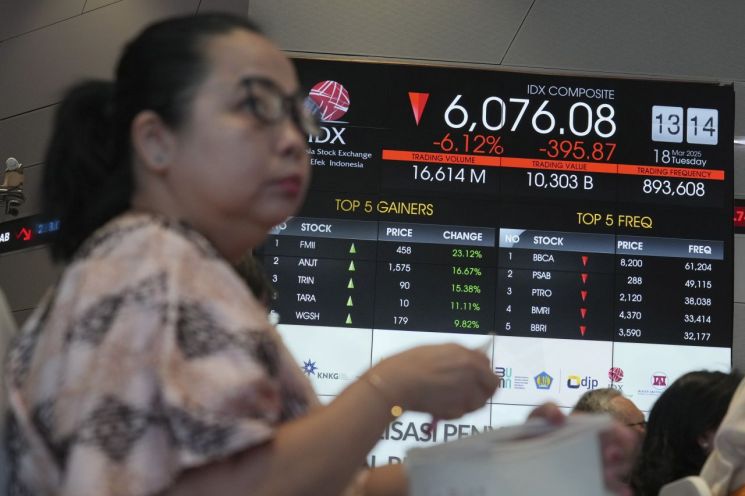 On the 18th, the Jakarta Composite Index (JCI) in Indonesia is declining. Photo by AP and Yonhap News.
According to the Indonesia Stock Exchange on the 18th, the Jakarta Composite Index (JCI) dropped more than 7% intraday. This is the first time since September 2011 that the JCI has fallen more than 7% intraday.
As the index plunged, trading was halted for the first time since the COVID-19 pandemic. The Indonesian stock market temporarily suspends trading for 30 minutes if the JCI falls more than 5%. However, the index recovered some losses in the afternoon and closed at 6223.39, down 3.84% from the previous day's closing price.
On this day, the Indonesian stock market was shaken by rumors that one of the world's top three credit rating agencies would downgrade the country's credit rating and that Sri Mulyani, who has served as Indonesia’s Minister of Finance since 2016, would be dismissed.
Minister Mulyani has maintained fiscal soundness through strict fiscal policies since the administration of Joko Widodo. However, under the current government, she has clashed with President Prabowo Subianto, who seeks to expand fiscal spending, leading to rumors that she might step down as Minister of Finance.
Adding to this, ahead of Indonesia’s largest holiday, Lebaran, companies struggling to provide bonuses have been laying off workers, and some are facing liquidity crises. Although the presidential office intervened to calm the market by stating that Minister Mulyani will not resign, the decline could not be stopped.
Foreign investors, concerned about Indonesia’s economic slowdown this year and uneasy about the new government’s various infrastructure budget cuts and economic policies, are massively withdrawing from the financial market.
The launch of the new sovereign wealth fund Danantra, which manages Indonesia’s state-owned enterprises, has also unsettled investors. Danantra will manage state-owned enterprises that account for more than 20% of the JCI, raising concerns about excessive government influence. Furthermore, with the Indonesian government’s plan to supply 3 million housing units annually, there are expectations that a large amount of bonds will be issued through state-owned enterprises, increasing financial market instability.
As a result, the JCI, which reached an all-time high above 7,900 last September, is now threatened to fall below the 6,000 level. Foreign investors have net sold $1.65 billion (approximately 2.4 trillion KRW) worth of Indonesian stocks this year. The exchange rate has also surged significantly, with the rupiah’s value against the dollar remaining at its lowest level since the 1998 Asian financial crisis.
© The Asia Business Daily(www.asiae.co.kr). All rights reserved.











