Demonstration of AI-Based Lighting Identification Solution
Korea Photonics Technology Institute Unveils Automated Light Pollution Analysis System in Gwangju
Artificial lighting that brightens the night can sometimes become an unwelcome guest. The issue of 'light pollution,' which disrupts sleep and disturbs ecosystems due to improper lighting, is now being addressed with artificial intelligence (AI) technology unveiled for the first time in Gwangju.
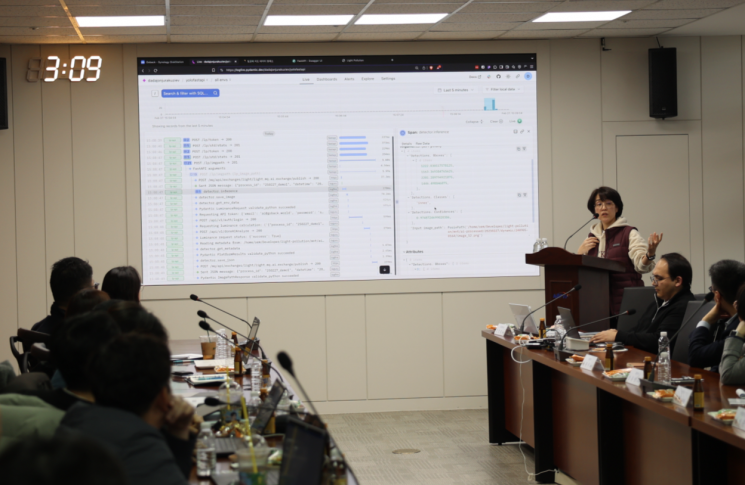 Kim Myunghee, Deputy General Manager of AI specialist company Goback Technology Co., Ltd., is explaining the operation of the AI light pollution image analysis solution and the process of displaying the light pollution GIS platform. Photo by Korea Photonics Technology Institute
The Korea Photonics Technology Institute recently announced on the 18th that it held a demonstration of its 'AI Light Pollution Image Analysis Solution' at its main office and LED Lighting Demonstration Center. This technology uses AI image recognition to automatically detect light pollution-causing lighting in photos and determine whether it exceeds regulatory limits.
The demonstration was attended by officials from the Ministry of Environment, the National Institute of Environmental Research, the Korea Environment Corporation, and the National IT Industry Promotion Agency (NIPA). At the event, AI analyzed photo data collected by luminance meters and displayed regional light pollution levels on a GIS-based map.
This solution automatically filters out duplicate or similar photos, deletes personal information such as faces or vehicle license plates, and extracts only the brightness of the lighting. The analysis time has been reduced to one-sixth of the previous duration, with a duplicate photo identification accuracy of 88% and lighting detection/classification precision of over 0.81.
This technology has advanced to a level applicable in real life through joint research with Gwangju City last year. The development team plans to increase accuracy to over 95% and utilize the system for light pollution management in all 17 metropolitan local governments nationwide.
Shin Kyungho, head of the Smart Lighting Research Center, said, "With the addition of the AI solution, the Ministry of Environment's light pollution management will become much more efficient," adding, "We will continue to advance the technology so that the public can enjoy a pleasant environment."
This project is being promoted as a three-year initiative supported by the Ministry of Science and ICT and NIPA, with participation from five organizations including Goback Technology Co., Ltd.
© The Asia Business Daily(www.asiae.co.kr). All rights reserved.












