Buying Sentiment Grows After Lifting of Land Transaction Permit System
Seoul Home Sale Prices Rise 0.18% in February
Largest Increase Since Last November
Transactions Also Increase in Areas with High Unsold Inventory
Last month, Seoul housing prices rose the most in three months. Centered around the Gangnam 3 districts, housing prices surged, increasing the overall rise in Seoul's housing market. Experts forecast that the buying sentiment triggered by the lifting of the land transaction permit zone on the 12th of last month is gradually spreading to major areas in Seoul and is unlikely to subside anytime soon. On the other hand, Seoul Mayor Oh Se-hoon, who stated that the land transaction permit system would be reinstated if excessive housing price increases occur, evaluated that "(the current housing price rise) is open to interpretation (controversy)."
According to the 'National Housing Price Trend Survey' released by the Korea Real Estate Board on the 18th, the housing (including apartments, row houses, and detached houses) sales price index in Seoul last month rose by 0.18% compared to the previous month. This is the largest increase since November last year (0.20%).
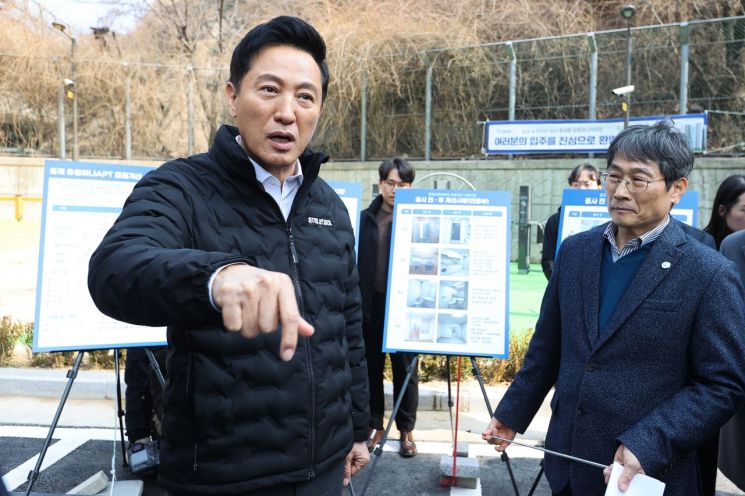 Seoul Mayor Oh Se-hoon visited Hongje Uwon Hana Apartment in Seodaemun-gu, Seoul, on the afternoon of the 10th, touring the apartment where residents have begun moving in after interior and exterior renovation work was completed, while listening to explanations from officials. Photo by Yonhap News.
◆Seoul Housing Price Rise, Highest in 3 Months= The driving force behind Seoul's housing price increase was the 'Gangnam 3 districts.' Housing prices in Songpa (0.94%), Seocho (0.74%), and Gangnam (0.68%) surged. Songpa and Gangnam, where the land transaction permit system was lifted on the 12th of last month, recorded their largest increases in six and four months, respectively. Seocho saw its highest rise in five months. Yongsan (0.24%), Gangdong (0.16%), Gwangjin (0.15%), and Mapo (0.14%) also experienced increases.
Despite declines in Nowon (-0.07%), Dobong (-0.04%), Gangbuk (-0.03%), Guro (-0.03%), and Eunpyeong (-0.02%), the soaring housing prices in these areas led to a significant overall rise in Seoul's housing market.
The entire metropolitan area housing prices declined due to Gyeonggi (-0.10%) and Incheon (-0.20%). However, as Seoul housing prices surged, the rate of decline narrowed from -0.06% in January to -0.01% in February. Nationwide housing prices also fell by 0.06%, showing a smaller decline compared to the previous month (-0.10%).
Among housing types, the increase in apartment transaction volume drove the price rise. According to the real estate information platform Dabang, last month, Seoul apartment transactions totaled 5,171, a 91% increase compared to 2,714 in the same period last year. In contrast, row houses and multi-family houses recorded 1,858 transactions, only a 2% increase from 1,816 in the same period last year. Compared to January this year, Seoul apartment transactions rose 54% from 3,367, while row houses and multi-family houses increased 17% from 1,593.
Especially, apartment transaction volumes in the Gangnam 3 districts, including Jamsil, Samsung, Daechi, and Cheongdam-dong?areas where the land transaction permit system was lifted?significantly increased. Last month, apartment transactions in the Gangnam 3 districts reached 1,105, a 137% increase from 466 in the same period last year. However, row house and multi-family house transactions were only 159, a 24% decrease from 208 in the same period last year.

◆Oh Se-hoon: "Housing Price Surge Open to Interpretation"= A Dabang official said, "Although apartment transaction volumes and sales prices are rising due to the announcement of the lifting of the land transaction permit zone, the impact on row houses and multi-family houses is minimal," adding, "Despite deregulation, the long-term effects of jeonse fraud-induced jeonse phobia and the stagnation of the non-apartment market seem to be continuously affecting the overall market."
Park Won-gap, Senior Real Estate Specialist at KB Kookmin Bank, said, "Demand for loans is surging before the implementation of the third stage of the total debt service ratio (DSR) in July," adding, "Along with expectations of interest rate cuts, increased liquidity, and anxiety, the issue of lifting the land transaction permit system is causing the market to react sensitively." He said, "Due to the impact of lifting the land transaction permit system, transaction volumes are increasing not only in Seoul but also in problematic unsold areas like Pyeongtaek," and added, "Since transaction volumes precede market prices, the price rise is unlikely to subside easily for at least the next month."
While the lifting of the land transaction permit system is being pointed out as the cause of the housing price rise in the market, Seoul Mayor Oh Se-hoon stated on the 17th, "There is room for interpretation regarding whether prices have risen abnormally." He emphasized, "We are closely monitoring whether extraordinary measures are necessary." Regarding the criteria for excessive housing price increases, he said, "There can be no special standard for whether the price rise is abnormal or normal. We are observing changes in transaction volumes and the degree of price increases," adding, "It seems we should judge based on common sense." Earlier, on the 14th, Seoul City announced at a real estate market task force (TF) meeting that if housing prices rise excessively abnormally, it would immediately push for the reinstatement of the land transaction permit system.
© The Asia Business Daily(www.asiae.co.kr). All rights reserved.













