1.09 People... Ranked 5th Among Cities Nationwide
According to the provisional 2024 birth and death statistics released by Statistics Korea on the 26th of last month, the total fertility rate in Gwangyang City rebounded to 1.09 after two years, returning to above one, and ranked fifth among the 78 cities nationwide.
The total fertility rate is a representative indicator showing the average number of children a woman is expected to have during her reproductive years (ages 15-49), reflecting the fertility level of a country or region.
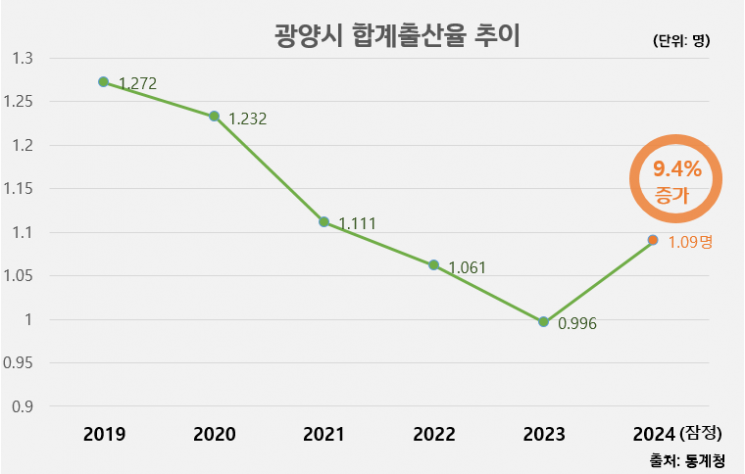 According to Statistics Korea, Gwangyang City's total fertility rate rebounded to 1.09 in two years, ranking 5th among 78 cities nationwide. Provided by Gwangyang City
Since 1998, South Korea's total fertility rate has continuously decreased to below 1.5, and in recent years, it has reached the world's lowest level, raising serious concerns that the risk of local extinction could escalate into a national crisis.
In this context, the number of births in Gwangyang City in 2024 reached 941, an increase of 109 (13.1%) compared to 2023. The number of marriages, which is a leading indicator of births, also rose by 25.9% in 2024 to 880 couples compared to the previous year.
An official from Gwangyang City explained, "The reason for the increase in births and the rebound in the total fertility rate is that those born between 1991 and 1995, who make up a large population group, have entered their 30s, and the number of marriages, which had been delayed during the COVID-19 pandemic, has been on the rise, leading to more births."
He added, "Furthermore, as local governments like Gwangyang City continue to implement active support policies, the economic burden on families giving birth has been reduced, and positive perceptions of childbirth have increased, which likely contributed as well."
The Times noted that while Gwangyang is neither famous nor glamorous and is far from the sophistication of the capital Seoul, its 'pregnancy and childbirth support policies that encourage couples to have children' stand out.
In addition, Gwangyang Mayor Jung Inhwa responded as follows to The Times reporter's questions about whether the low birthrate problem is solvable and what strategies there are to overcome it.
"Our society is facing a national extinction crisis. Having and raising children involves many difficulties and high costs, but if appropriate incentives are provided, it is a problem that can be overcome," he said, citing the 'detailed welfare policies for each stage of the life cycle,' which he has considered since before taking office, as his strategy for overcoming the issue.
In this regard, a Gwangyang City official elaborated, "Population decline is not a problem that can be solved in a short period of time, so it is important to prepare in advance and establish continuous countermeasures. To achieve this, it is necessary to create an environment for education and employment so that the younger generation can settle down, and to strengthen welfare for the elderly in line with an aging society, ensuring balanced policies," emphasizing the importance of detailed welfare policies tailored to each stage of life.
The city has set the ultimate goal of driving population growth by implementing population policies based on the nation's best life-cycle welfare platform. Currently, the city's Life-Cycle Welfare Platform 1.0 includes about 370 welfare policies, and by the end of this year, the plan is to fill the Life-Cycle Welfare Platform 2.0 with a total of 400 policies.
Generally, the life cycle is divided into infancy, childhood, adolescence, youth, middle age, adulthood, and old age. Gwangyang City has added the fetal period and is developing and implementing customized welfare policies from the fetal stage to old age.
Based on these active pregnancy and childbirth support and population policies, Gwangyang City is the only one among the 22 cities and counties in Jeonnam Province to record population growth for three consecutive years.
Lee Hyang, head of the Birth and Health Division, said, "Since not all local governments can solve population issues in the same way, we will continue to communicate with citizens and develop new ideas so that the decision to marry in Gwangyang can lead to the decision to have children and the desire to live here for a lifetime, by supporting customized strategies."
© The Asia Business Daily(www.asiae.co.kr). All rights reserved.











