FT Editorial: Trump Administration Presents Broad Challenges to Asian Countries
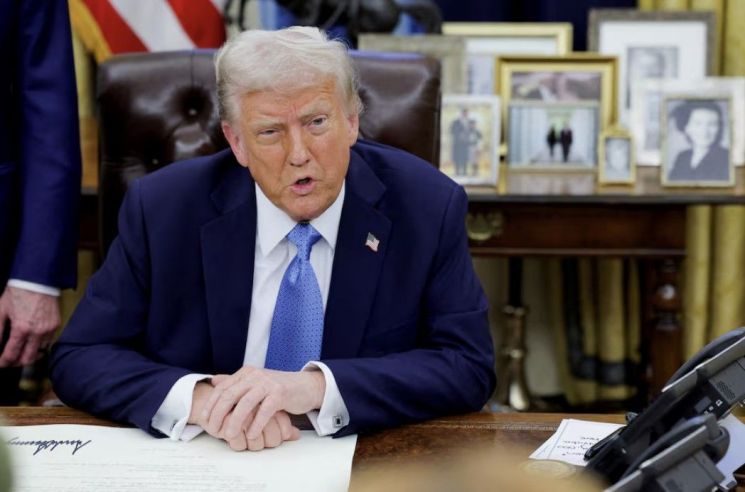 Donald Trump, President of the United States, is signing an executive order in the White House Oval Office.
There is a view that changes in the diplomatic policy of the second Trump administration toward its allies will pose a significant challenge to South Korea and Japan. An increase in defense spending by both countries appears inevitable, and ideas for a new alliance among U.S. allies, similar to a so-called "Asian NATO," have also been proposed.
On the 16th (local time), the British Financial Times (FT), in an editorial titled "Asia's U.S. Allies Must Rethink Defense," pointed out that the U.S. has become an unreliable partner for alliances such as NATO, posing a broad challenge to democratic countries in Asia that have long relied on the U.S. for security.
This will affect the Asia region facing the rise of authoritarian and coercive China, and the FT predicted it will be especially serious for South Korea and Japan, where alliances with the U.S. have been the cornerstone of national security since the 1950s.
The FT assessed that, on the surface, the South Korea-U.S. and Japan-U.S. relationships remain solid. Currently, about 28,000 U.S. troops are stationed in South Korea, and approximately 60,000 in Japan. The hawks on China within the Trump administration hope that President Trump will place greater importance on Asian allies, which is cited as a reason for this stability.
However, since its inception, the Trump administration has consistently pressured alliances such as NATO. It has repeatedly expressed dissatisfaction with the defense spending of NATO European member countries and has urged all members to reach 2% of their Gross Domestic Product (GDP) by the NATO summit in June, ultimately pushing for a target of 5%.
Furthermore, on the 6th, U.S. President Donald Trump expressed dissatisfaction with NATO European members' defense spending, stating, "We have a very interesting treaty with Japan. We have a good relationship with Japan, but we have to protect Japan, whereas Japan does not have to protect us," referring to the U.S.-Japan Security Treaty.
The FT suggested that South Korea and Japan could increase their defense budgets and consider forming a new alliance among U.S. allies, akin to an "Asian NATO." Regarding defense spending, the FT proposed that South Korea and Japan could spend more to alleviate U.S. complaints about free-riding. Currently, South Korea's defense budget accounts for 2.8% of its GDP, and Japan's is 2%.
The FT also raised the necessity of an alliance among U.S. allies in Asia to strengthen cooperation with both regional and extra-regional democratic countries. Previously, Japan's Shigeru Ishiba, before taking office as prime minister, advocated for the creation of an "Asian NATO" as a security initiative.
However, the FT pointed out that for this to happen, relations between South Korea and Japan must improve. Even the foundational step of an alliance between South Korea and Japan is very complicated due to South Korea's anger over Japan's past colonial rule and Japan's pacifist constitution.
Moreover, the FT reported that efforts to improve South Korea-Japan relations are in doubt as South Korean President Yoon Suk-yeol, who was pursuing rapprochement, has been impeached, and Prime Minister Ishiba's influence is limited after the ruling Liberal Democratic Party failed to secure a majority in last year's general election.
Additionally, the daily newspaper added that if trust in the U.S. nuclear umbrella decreases, allies will inevitably consider developing their own nuclear weapons, which is already a widely discussed option in South Korea.
© The Asia Business Daily(www.asiae.co.kr). All rights reserved.











