846 Billion KRW to Be Invested Over 5 Years for 31 Action Plans
"OECM Introduction and More for a Sustainable Ecological City"
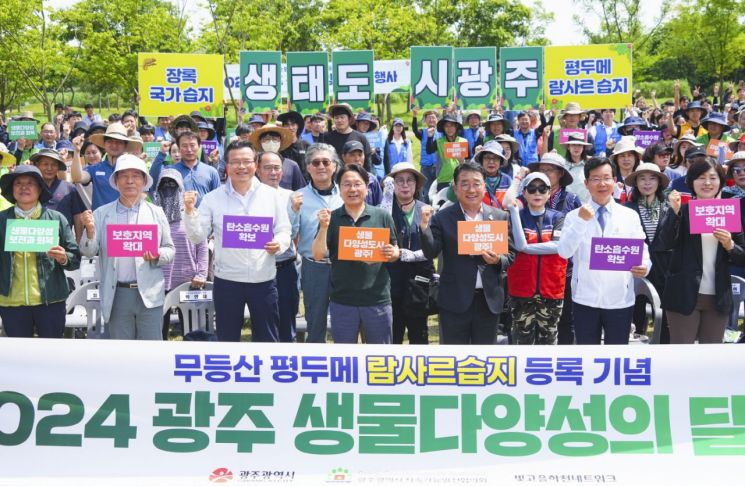 Gwangju Mayor Kang Gijeong attended the "2024 Gwangju Biodiversity Month" event held on May 20 last year at Hwangryong Chinsu Park in Gwangsan District, where he participated in a picket performance with guests including Gwangsan District Mayor Park Byunggyu, Gwangju City Council Chairman Jung Muchang, and Yeongsangang River Basin Environmental Office Director Park Yeonjae. Photo by Gwangju City
Gwangju City has established a “Regional Biodiversity Strategy” that includes urban ecological axis and degraded area restoration, the introduction of the Other Effective area-based Conservation Measures (OECM) system, and more, leading the way in creating a sustainable ecological city that coexists with nature.
According to Gwangju City on the 17th, a total of 84.6 billion KRW (36 billion KRW from the national government and 48.6 billion KRW from the city) will be invested by 2029 to implement the “Gwangju Biodiversity Strategy,” which consists of three strategies and 31 detailed action plans: ▲Strengthening biodiversity conservation ▲Increasing ecosystem service benefits ▲Mainstreaming biodiversity.
First, to “strengthen biodiversity conservation,” the city will carry out 14 projects, including urban ecological axis and degraded area restoration, the introduction of the OECM system, the designation of Jangrok Wetland as a Ramsar Wetland, and the creation of carbon sinks. In connection with the Ministry of Environment’s “5th National Biodiversity Strategy (2024-2028),” the city plans to focus on identifying OECMs within the urban area to help achieve the national goal of managing 30% of the national territory as protected areas by 2030.
To “increase ecosystem service benefits,” the city will promote eight projects, including the evaluation of urban ecosystem service value and the development of unique indicators, expansion of urban green spaces and parks, and the creation and management of ecological forests. Through these efforts, the city expects to conserve unique local ecological resources and provide citizens with a variety of ecosystem services.
For “mainstreaming biodiversity,” nine projects will be implemented to expand citizen participation and strengthen community cooperation, including biodiversity awareness promotion, operation of biodiversity exploration (BioBlitz), citizen-participatory endangered wildlife monitoring, and support for ESG activities by local businesses.
Gwangju’s “Regional Biodiversity Strategy” was developed through a variety of feedback processes, beginning with the Gwangju Research Institute’s “Study on the Establishment and Activation of Biodiversity Strategies,” followed by consultations with the National Institute of Biological Resources under the Ministry of Environment, briefing sessions, and deliberations by the Environmental Policy Committee last year.
The Ministry of Environment recommends the establishment of regional biodiversity strategies, recognizing that biodiversity conservation is essential for responding to climate change and achieving sustainable development, and that practical conservation efforts at the local level play a key role in achieving national goals.
Kim Osuk, Head of the Environmental Conservation Division, stated, “It is highly significant that we have established an effective regional biodiversity strategy for the first time in the Honam region,” and added, “We will continue to promote biodiversity conservation policies so that Gwangju can leap forward as a sustainable ecological city where people and nature coexist.”
© The Asia Business Daily(www.asiae.co.kr). All rights reserved.

![Clutching a Stolen Dior Bag, Saying "I Hate Being Poor but Real"... The Grotesque Con of a "Human Knockoff" [Slate]](https://cwcontent.asiae.co.kr/asiaresize/183/2026021902243444107_1771435474.jpg)














