"Civil Servants' Political Activities Should Be Freely Allowed"
On the 16th, the Expert Committee on the Application of ILO Conventions and Recommendations publicly disclosed its second "direct request" to the Korean government regarding the Trade Union and Labor Relations Adjustment Act and related matters.
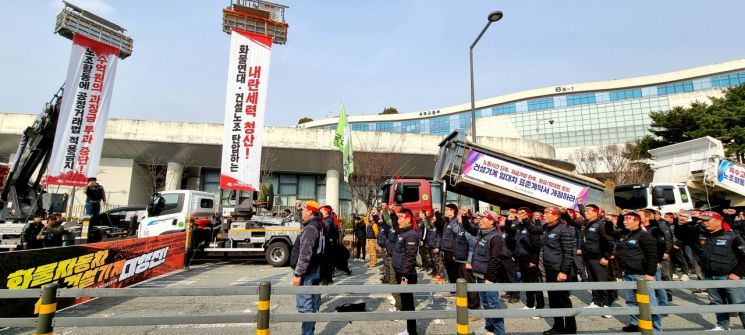 Members of the Cargo Solidarity Headquarters of the Public Transport Union (Cargo Solidarity) and the National Construction Workers' Union (Construction Union) are urging the dismissal of President Yoon Seok-yeol, the introduction of a safe freight rate system, and the cessation of oppression against the Construction Union in front of the Ministry of Land, Infrastructure and Transport at the Government Sejong Complex on the 7th. Photo by Yonhap News
According to the ILO website and the Korean Confederation of Trade Unions (KCTU) on the day, the ILO Expert Committee reviewed the implementation status of ILO Conventions No. 87 (Freedom of Association and Protection of the Right to Organize) and No. 98 (Application of the Principles of the Right to Organize and Collective Bargaining) and made specific recommendations to the Korean government on areas needing improvement.
A "direct request" is when the Expert Committee asks member states practical questions or requests additional information before expressing its views on the matter. In March last year, the ILO made its first direct request regarding the same conventions.
First, the Expert Committee noted that the President exercised a veto on labor-related laws (Articles 2 and 3 of the Trade Union Act) passed by the National Assembly. It added, "We expect the government to take measures to allow social dialogue participants to fully discuss contentious issues from the perspective of promptly applying necessary amendments to align with international conventions."
Specifically, it stated, "We once again remind that independent self-employed persons, agricultural workers, freelancers, non-standard employment workers, and platform workers should be considered workers for the purpose of applying the conventions and thus have the right to organize. The government must ensure their rights are protected both in law and in practice."
Regarding the scope of legitimate industrial action, it requested, "Necessary measures should be taken through social consensus to allow strikes related not only to labor disputes but also to government economic and social policies, including solidarity strikes."
It also reaffirmed its position on the freedom of political activities for civil servants, stating, "They should be allowed to publicly express opinions on economic and social issues that directly affect union members' interests," and expressed hope that the National Public Officials Act will be amended to ease such restrictions.
The committee also reiterated calls for the amendment of Article 11 (Prohibition of Industrial Action) and the abolition of Article 18 (Penalties) of the Public Officials Trade Union Act, which restrict strike rights, as well as amendments to Articles 8 and 15(1) (Prohibition of Industrial Action and Penalties for Violations) of the Teachers' Trade Union Act.
Regarding Article 27 of the Trade Union Act, which requires unions to report on accounting settlements and operational status, the Expert Committee explained, "It should be clarified after review to ensure it is not applied in a way that obstructs the functions of trade unions." Concerning the accounting disclosure introduced in 2023, it urged, "Clarify whether accounting disclosure is mandatory and take necessary measures to ensure these requirements are not applied in a way that hinders union functions."
The government must correct the issues pointed out by the Expert Committee in accordance with the committee's recommendations and report the results before the next report submission deadlines (September 2026 and September 2027). However, the Ministry of Employment and Labor stated that this request is typically made based on member states' reports on the implementation of ratified conventions and has no binding force under international law.
© The Asia Business Daily(www.asiae.co.kr). All rights reserved.












