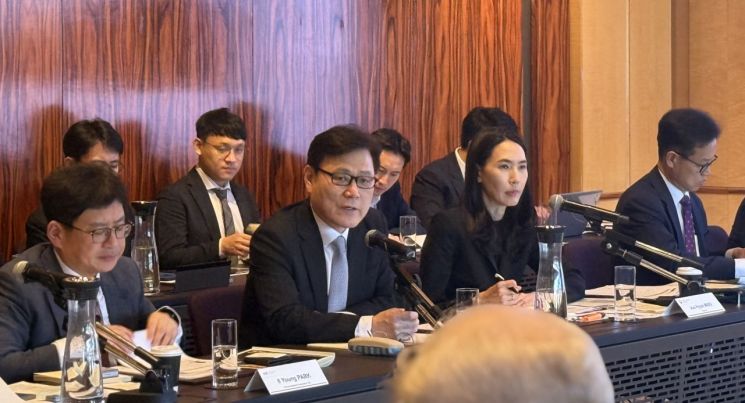
Choi Jong-gu, Ambassador for International Financial Cooperation, stated, "Korea's political uncertainties are being resolved in an orderly manner, and through a robust economic system, Korea's financial and foreign exchange markets have quickly recovered."
According to the Ministry of Economy and Finance on the 16th, Ambassador Choi visited New York on the 11th (local time) to hold a Korean economic briefing (IR) for Wall Street investors. The IR was attended by key senior executives from major Wall Street asset management firms, including BlackRock, the world's largest asset manager; PIMCO, one of the world's largest bond managers; and Goldman Sachs.
Ambassador Choi also pointed out that major credit rating agencies have maintained Korea's sovereign credit rating, emphasizing that "Korea's external creditworthiness remains solid."
He highlighted Korea's strong fundamentals, such as stable foreign exchange reserves ranked 9th globally, a lower government debt ratio compared to major countries, and robust exports based on semiconductors and secondary batteries, stressing that Korea is a high-value investment destination.
Regarding Korea's bond market, which ranks 12th globally with a scale of approximately $800 billion, he also informed that Korea is scheduled to be included in the World Government Bond Index (WGBI) in November this year.
In response to investors' questions about countermeasures against the U.S. government's tariff imposition moves, he replied, "Since Korea's effective tariff rate on U.S. imports was about 0.79% last year, we will actively dispel misunderstandings in the U.S. through various channels," adding, "We will consult with the U.S. to ensure mutual benefits in sectors of high U.S. interest such as shipbuilding and energy."
He explained that following the inclusion in the WGBI, Korea's inclusion in the Morgan Stanley Capital International (MSCI) Developed Markets Index could naturally follow.
Regarding Korea's medium- to long-term economic direction, including raising potential growth rates, he introduced government policies, stating, "Addressing low birth rates and aging population issues, discovering and nurturing new industries, and structural reforms to enhance productivity are important."
Ambassador Choi also separately met with senior officials from major financial institutions, including Fiona Bassett, CEO of the Financial Times Stock Exchange (FTSE) Russell.
During the meeting with CEO Bassett, they discussed the final preparations for Korea's inclusion in the WGBI and the progress of advanced policies in the foreign exchange and capital markets.
In the meeting with MSCI representatives, he explained the Korean government's efforts to improve accessibility to Korea's stock market, capital, and foreign exchange markets.
Evan Russo, CEO of Lazard Asset Management, told Ambassador Choi during their meeting, "Since many difficulties have been resolved, we are ready to further expand investments," adding, "Given Korea's key position in the global supply chain, it should actively leverage its advantage over other countries in cooperation with the U.S."
The board members of the Korean Financial Society (KFS), which has about 4,000 members, advised Ambassador Choi that while the views of U.S.-based financial professionals who assess the Korean economy as stable have not changed significantly, proactive government explanations would help alleviate vague anxieties among some investors.
A government official said, "We confirmed positive evaluations from investors regarding government efforts during activities in New York," adding, "Ambassador Choi will continue close communication efforts with local investors by visiting countries such as Japan ahead of the final review for WGBI inclusion in April."
© The Asia Business Daily(www.asiae.co.kr). All rights reserved.












