Exports in March started on an upward trend. However, semiconductor exports showed a growth rate in the 0% range, essentially remaining flat. The government recently assessed that the Korean economy is facing increased downward pressure due to a slowdown in export growth and weakening economic sentiment.
According to the Korea Customs Service on the 16th, export value from March 1 to 10 was $13.9 billion, a 2.9% increase compared to the same period last year.
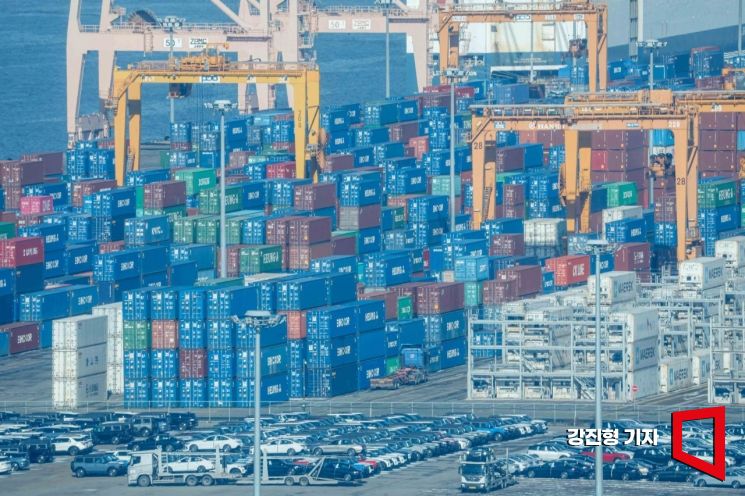 President Donald Trump signed a proclamation imposing a 25% tariff without exceptions on steel and aluminum products imported into the United States, and announced that tariffs on automobiles and semiconductors are also under consideration. On the 13th, containers were piled up at Pyeongtaek Port in Gyeonggi Province. 2025.2.13. Photo by Kang Jin-hyung
The number of working days was 5.5, 0.5 days fewer than the same period last year. Considering this, the average daily export value rose 12.3% to $2.52 billion.
Exports had recorded positive growth for 15 consecutive months until December last year. However, due to the Lunar New Year holiday and other factors, exports declined in January this year but showed an increase again last month.
Among the top 10 major export items, six items including petroleum products (-0.7%), steel products (-7.8%), and automobile parts (-7.6%) decreased. Ship exports increased by 55.2%, and passenger cars by 6.2%. Semiconductor exports barely increased by 0.03%. As a result, the share of semiconductor exports fell by 0.6 percentage points year-on-year to 19.8%. By country, exports to the United States (5.5%), the European Union (EU, 6.8%), and Vietnam (6.8%) increased, while exports to China (-6.6%) and Hong Kong (-23.7%) decreased.
Imports from March 1 to 10 amounted to $15.9 billion, up 7.3% year-on-year. Crude oil (4.4%), semiconductors (12.9%), and semiconductor equipment (94.6%) increased, whereas machinery (-7.3%) and petroleum products (-19.2%) decreased. By country, imports from China (4.1%), the EU (29.7%), and Japan (9.8%) increased, while imports from the United States (-3.7%) and Saudi Arabia (-1.0%) declined.
With imports rising more than exports, the trade balance recorded a deficit of $2 billion. Including this, the cumulative trade surplus for this year narrowed to $308 million.
On the 14th, the Ministry of Economy and Finance evaluated in the March issue of the 'Recent Economic Trends (Green Book)' that downward pressure on the economy has increased. They specifically added that the export growth trend is slowing. A ministry official explained, "In January, there was a significant negative due to the Lunar New Year holiday, followed by a return to positive growth in February, but the magnitude of the turnaround was not large," adding, "Compared to last year's strong export growth, the pace of increase has slowed."
© The Asia Business Daily(www.asiae.co.kr). All rights reserved.












