Employment Environment Worsens Despite Favorable Indicators
Report Reveals Unemployment Rises Due to Economic Slowdown
Majority of Unemployed Attributed to Decreased Labor Demand
Although domestic employment market indicators showed favorable figures, a report revealed that the employment environment is deteriorating due to an increase in unemployment caused by economic slowdown.
On the 15th, Hyundai Research Institute stated this in its report titled "Employment Conditions Hidden Behind Favorable Indicators."
According to the report, after the COVID-19 pandemic, the domestic economic growth rate contracted by -0.7% in 2020 but rebounded to 4.6% in 2021. However, it gradually slowed to 2.7% in 2022, 1.4% in 2023, and 2.0% in 2024.
Nevertheless, the unemployment rate recorded a historic low of 2.7% in 2023, and the employment rate also hit an all-time high of 62.7% last year.
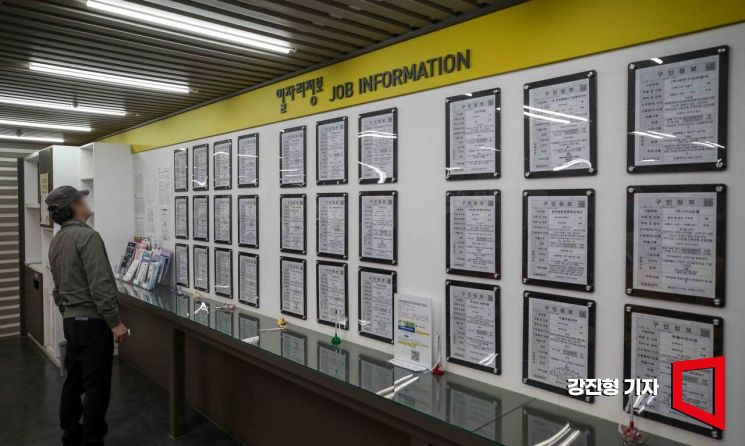 On the 13th, the number of employed people in October increased by 83,000 compared to the same month last year, dropping below 100,000 for the first time in four months. A job seeker visiting an employment center in Seoul is looking at the job posting board. Photo by Kang Jin-hyung
Based on an analysis using Worknet job vacancy and job seeker statistics from 2022 to last year, the institute found that the nationwide number of unemployed persons last year was 3.13 million, similar to the previous year (3.16 million).
However, analyzing the types of unemployment, the proportion of labor demand shortage (cyclical) unemployment was 71.6% last year, higher than 45.5% in 2022 and 56.2% in 2023.
Labor demand shortage unemployment occurs when total demand decreases during an economic downturn, reducing labor demand. In other words, 70% of last year’s unemployment was caused by economic slowdown.
On the other hand, the proportion of structural unemployment decreased from 24.0% in 2022 to 20.5% in 2023 and 8.8% last year. Structural unemployment arises when changes in industrial structure due to economic growth cause a mismatch between the skills or abilities of unemployed persons and those required by the market. This type is likely to lead to chronic unemployment.
The institute emphasized the need for close examination of the employment market and efforts to improve the actual employment environment and its perception, stating, “Since an increase in unemployment due to economic slowdown is observed in micro employment data, it is necessary to enhance efforts for economic recovery, implement region-specific tailored employment policies, and strengthen market-driven employment creation systems.”
© The Asia Business Daily(www.asiae.co.kr). All rights reserved.












