Support for the Vulnerable, Including Persons with Disabilities...
10 Additional Regulatory Abolition Measures
Removal of Business Inconveniences for Small Business Owners, Ordinance Amendments
Expansion of Policy Benefits for Housing and Transportation Vulnerable Groups
Reducing Inconveniences for Citizens and Companies in Project Participation and Contracting
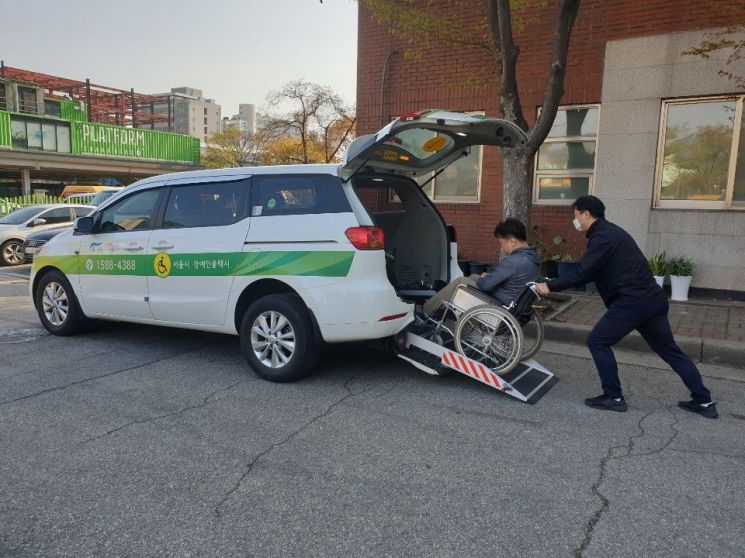
From now on, disability call taxis that can accommodate bedridden disabled persons using bed-type wheelchairs will be introduced. In addition, related regulations will be abolished to allow mentally disabled individuals who previously could not ride without a guardian to ride alone, provided they do not require probation supervision.
On the 16th, the Seoul Metropolitan Government announced regulatory abolition proposals No. 74 to 83, aiming to lower the policy benefit barriers for socially vulnerable groups such as disabled persons and disadvantaged youth. After setting regulatory abolition as this year's key agenda, the city has released a total of 83 regulatory abolition proposals to date, including the 10 newly added ones this time, covering construction, enterprises, small business owners, disabled persons, multicultural families, and more, starting with the first regulatory abolition announcement on January 3.
The regulatory abolition proposal No. 74 announced that day is the 'Relaxation of regulations on signboards for small business owners.' Currently, outdoor advertising production is only allowed using non-ferrous metal materials such as wood and acrylic according to the ordinance, but these materials are vulnerable to corrosion and other external environmental changes and are costly to produce. Reflecting the reality that small business owners have been illegally producing and using steel signboards, the city is preparing to amend the ordinance to relax the signboard material from 'non-ferrous metal' to 'metal, etc.'
No. 75 is the 'Relaxation of the regulation requiring operators of sidewalk business facilities (street vending stands, shoe repair stands) to post operator certificates externally.' According to the ordinance enacted 10 years ago in 2015, operators must post certificates containing their photo, name, and date of birth both inside and outside the facility, and violations can result in penalty points and even permit cancellation if points accumulate. However, operators have continuously filed complaints, citing unnecessary regulations that risk personal information leakage.
No. 76 is the 'Relaxation of asset deduction criteria for Seoul-type rental deposit support.' The 'Seoul-type Rental Deposit Support Project' provides up to 6.5 million KRW per household to vulnerable households in housing crises with a median income of 120% or less residing in Seoul. Previously, if the applicant had a deposit at their current residence, the support amount was reduced by the full deposit amount from the maximum 6.5 million KRW. The new policy deducts only the amount exceeding 3.5 million KRW before providing support.
Benefits for disabled persons were also introduced. No. 77 is the 'Introduction of bedridden disabled call taxis and relaxation of restrictions on solo rides for mentally disabled persons.' Currently, disability call taxis are only available to non-wheelchair users or users of 'standard wheelchairs,' but going forward, special vehicles will be introduced to allow bedridden disabled persons using bed-type wheelchairs to ride.
The procedure for mentally disabled persons to use disability call taxis has also been improved. Previously, a guardian had to accompany them, or a prior application form had to be submitted for solo rides, but the prior application procedure will be abolished. Mentally disabled persons who do not require continuous supervision by others can freely use taxis without a guardian, greatly enhancing user convenience.
No. 78 is the 'Relaxation of eligibility restrictions for participation in the Companion Job Project.' The related guidelines will be revised to allow economically struggling university and graduate students to participate. From April, university and graduate students who can work 30 hours per week will be able to participate in the Companion Job Project through the revised guidelines.
No. 79 is the 'Improvement of the Seoul Scholarship Foundation’s scholarship selection process.' This expands the income criteria application period from the current 'current semester' to 'the semester prior to the previous year.' This will be applied starting with the 'Seoul Hope University Career Scholarship' implemented in March, followed by the 'Seoul Overseas Exchange Student Scholarship' and the 'Descendants of Independence Patriots Scholarship.'
Regulatory abolition proposal No. 80 is the 'Digitization of mandatory contract document submission methods for contracts with the Seoul Design Foundation.' This changes the submission of proposals and contract documents by private companies from in-person visits to online submissions.
No. 81 is the 'Simplification of subsidy payment procedures.' The Seoul Metropolitan Government and Seoul Tourism Foundation provide various supports, including subsidies, to foreign groups visiting Seoul for corporate meetings and incentive tourism to expand foreign tourist attraction. Currently, the subsidy payment process requires travel agencies to first pay hotels or other venues for group events, then the foundation verifies supporting documents and reimburses the hotels, which then refund the travel agencies. This complicated process has caused operational inconvenience. Going forward, the payment procedure will be simplified so that travel agencies can receive MICE subsidies directly, improving administrative efficiency.
The 'Simplification of submission procedures for youth business application supporting documents' (No. 82) will also be promoted. Youth have repeatedly experienced the inconvenience of issuing and submitting the same supporting documents multiple times when applying for projects. To improve this, from March, with consent to provide personal information, documents submitted once will be reused for other youth project applications within a certain period.
Additionally, the 'De-designation of Yangjae-daero as a motor vehicle-only road' (No. 83) will be implemented. Although Yangjae-daero does not meet the criteria for a motor vehicle-only road, it has been designated and operated as such since 1989 for traffic flow reasons. This measure is expected to reduce the long detour burden on motorcycle riders. Kim Hyung-rae, Seoul City Planning Officer, stated, "We will continue to gather citizens' opinions to abolish regulations that do not fit reality and ease systems that increase citizen inconvenience and hassle, thereby enhancing both economic vitality and citizen convenience."
© The Asia Business Daily(www.asiae.co.kr). All rights reserved.












