Trump: "200% Tariff on All EU Alcoholic Beverages"
Yellen: "Focus on the Real Economy"
February PPI Unchanged from Previous Month... Inflation Concerns Ease
The three major indices of the U.S. New York stock market were in a downward trend in the early trading hours on the 13th (local time). Investor sentiment weakened after President Donald Trump warned of imposing a 200% tariff bomb on alcoholic beverages from the European Union (EU). The February wholesale price index remained stagnant, temporarily easing inflation concerns.
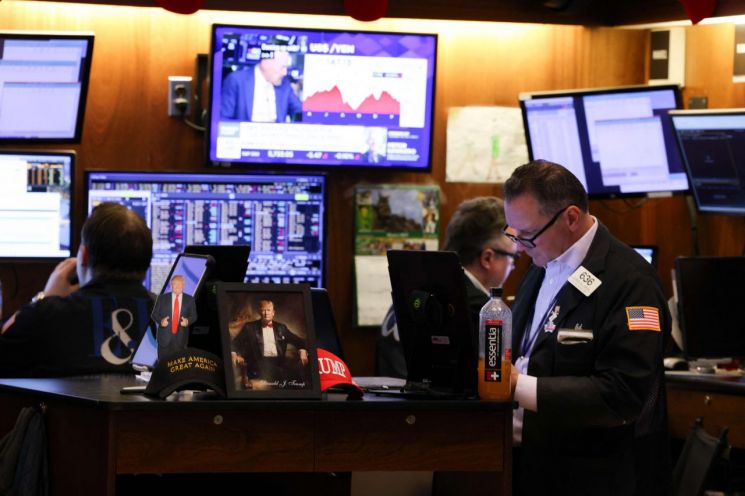
As of 11:09 a.m. in New York stock market on the day, the Dow Jones Industrial Average (Dow) focused on blue-chip stocks was down 253.3 points (0.61%) from the previous trading day, standing at 41,097.63. The S&P 500 index, centered on large-cap stocks, fell 40.29 points (0.71%) to 5,559.0, and the Nasdaq index, focused on technology stocks, dropped 208.07 points (1.18%) to 17,440.38.
By stock, Tesla was down 4.63%. After President Trump warned that he would not tolerate boycotts and attacks on Tesla, whose CEO is Elon Musk, head of the Department of Government Efficiency (DOGE), Tesla had risen 7.59% just the previous day. Boeing, the U.S. aircraft manufacturer, was down 0.23% despite Citigroup's analysis that the stock has a 32% upside potential. Nvidia was up 0.41%.
President Trump's tariff remarks are pulling the indices down. He warned that if the EU does not immediately lift the 50% tariff imposed on U.S.-made whiskey, he would impose a 200% tariff on all alcoholic beverages imported from EU countries. President Trump announced this via his social networking service (SNS) Truth Social, saying, "This will be a great help to the wine and champagne business in the U.S." Earlier, after the U.S. imposed a 25% tariff on all steel and aluminum imports as of the 12th, the EU included a 50% tariff on U.S.-made whiskey in its retaliatory measures to be implemented next month.
Amid growing concerns about a tariff-induced economic recession, U.S. Treasury Secretary Janet Yellen stated that she is focusing on the medium- to long-term soundness of the economy and markets. In an interview with CNBC, she said, "We are focusing on the real economy," and "I am not worried about a little market volatility over the next three weeks." While confirming the intention to continue tariff policies, her remarks appeared aimed at calming the market gripped by recession fears.
The February Producer Price Index (PPI) released that morning fell short of market expectations, easing inflation concerns. According to the U.S. Department of Labor, the PPI for February this year was flat compared to the previous month. It was significantly below the January figure (0.6%) and expert forecasts (0.3%). The decline in service prices by 0.2% month-on-month had a major impact. The PPI rose 3.2% year-on-year, also below the previous month's figure (3.7%) and market expectations (3.3%). Since the wholesale price index (PPI) affects the consumer price index (CPI) with a time lag, the stagnation of PPI last month partially alleviated inflation concerns. The February CPI released the previous day also gave the market relief, with a year-on-year increase of 2.8%, below both market expectations (2.9%) and the previous month's figure (3.0%). However, if the tariff policies continuously announced by President Donald Trump are fully reflected in the economy, it could lead to rising import prices and consumer price increases.
Paul Stanley, Chief Investment Officer (CIO) of Granite Bay Wealth Management, said, "Thursday's (13th) inflation data looks back at the past, but the real concern is the inflationary effect that tariff policies could cause," adding, "This will be an unpredictable wild card for the market and the U.S. Federal Reserve (Fed)."
The Fed is expected to keep the benchmark interest rate at the current 4.25-4.5% level at the Federal Open Market Committee (FOMC) regular meeting scheduled for the 18th-19th. It is likely to monitor inflation, growth rates, and employment indicators while assessing the impact of President Trump's trade policies in the future.
Employment appeared favorable. According to the U.S. Department of Labor, new unemployment claims for the week of March 2-8 decreased to 220,000, down from the revised figure of 222,000 the previous week, and below market expectations of 226,000.
Government bond yields remained steady. The U.S. 10-year Treasury yield, a global bond yield benchmark, stood at 4.31%, and the 2-year Treasury yield, sensitive to monetary policy, was at 3.99%, both moving around the previous day's levels.
© The Asia Business Daily(www.asiae.co.kr). All rights reserved.












