Ilyang Pharmaceutical Withdraws from Daiso, Prompting Fair Trade Commission Investigation of Pharmacists' Association
Controversy Expands, Generating Unexpected Publicity... Pharmacies Face Public Backlash
Daewoong Pharmaceutical and Chong Kun Dang Health Decide to Remain at Daiso
The conflict between pharmaceutical companies and pharmacies, which began with Daiso's "3,000 won" health functional foods (HFF), has escalated into a so-called "pharmacy power abuse" controversy and even led to an investigation by the Fair Trade Commission, leaving the parties involved in a dilemma. Among the three pharmaceutical companies, one has decided to withdraw from Daiso, while the other two are remaining tight-lipped, stating they will continue sales for the time being. The pharmacists' association, which has faced public backlash, is now at risk of being fined.
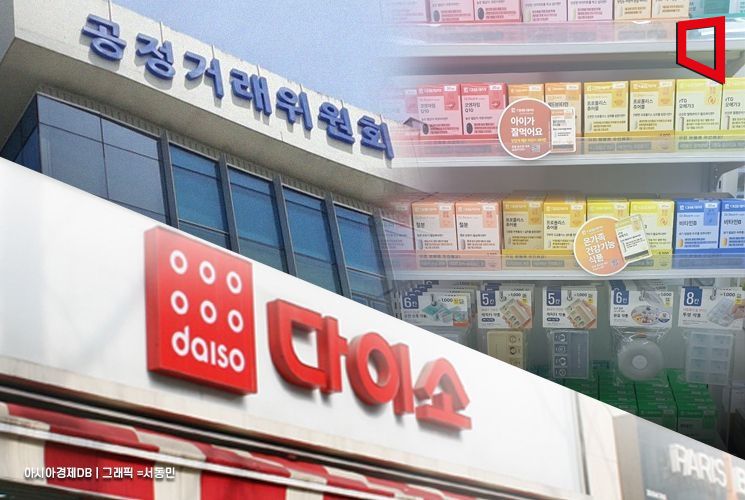
According to the industry on the 14th, pharmacies began to show discomfort after Daiso started selling HFF last month because three companies?Ilyang Pharmaceutical, Daewoong Pharmaceutical, and Chong Kun Dang Health?promoted their products by emphasizing that their prices were cheaper than those at pharmacies. They highlighted only the "price" without considering differences in ingredients, content, origin, auxiliary materials, volume, or packaging costs of the HFF, which led to the misunderstanding that pharmacies were making excessive profits from HFF.
In particular, some pharmacists reacted strongly, saying they would return all other medicines from pharmaceutical companies that entered Daiso and refuse to sell them, and even the Korean Pharmaceutical Association threatened, "We will monitor whether pharmaceutical companies reasonably improve the supply prices of HFF supplied to pharmacies in the future." Consumers perceived this as "pharmacy tyranny." Consumer groups also joined in, criticizing the pharmacists' association's demand for pharmaceutical companies to stop selling at Daiso as "an unfair measure restricting consumer choice and an infringement on consumer rights."
Eventually, five days after launching HFF at Daiso, Ilyang Pharmaceutical decided to withdraw, raising suspicions that the pharmacists' association exerted undue pressure. On the 13th, the Fair Trade Commission dispatched investigators to the pharmacists' association to conduct an on-site investigation into possible violations of the Fair Trade Act.
Experts point out that in the rapidly changing consumer trends, pharmacists, who were once fixated on the traditional "dominant-subordinate" status, have been hit by a boomerang effect. Consumers are already purchasing food at Daiso and receiving HFF via dawn delivery, so restricting pharmaceutical companies' distribution channels does not mean they will buy HFF from pharmacies. An industry insider said, "Pharmaceutical companies likely anticipated the pharmacies' backlash when deciding to sell at Daiso. The more the controversy grows, the more it promotes the products and increases sales."
The attempt by pharmaceutical companies to break away from their main distribution channel?the pharmacies?and seek new sales routes to expand consumer choice has been seen as refreshing. Until now, domestic HFF sales have been heavily skewed toward online distribution, with internet malls accounting for 70% of sales. The perception that HFF can also be purchased at Daiso, an offline discount household goods store, has spread. For example, cosmetics retailer CJ Olive Young and convenience store CU have already launched their own private brand (PB) HFF or operate specialized stores for HFF sales as their HFF sales continue to grow.
The pharmaceutical companies find themselves in a difficult position. Public opinion against pharmacies is worsening, and with the Fair Trade Commission watching, stopping sales could further complicate relationships with pharmacies, their long-standing clients and customers. Unlike Ilyang Pharmaceutical, Daewoong Pharmaceutical has decided to maintain its supply to Daiso. Chong Kun Dang Health is also expected to make a similar decision soon.
Attorney Kim Tae-min (Food Hygiene Law Research Institute) said, "HFF manufactured with recognized functional ingredients all have the same components, so there is no difference in quality. However, each manufacturer sets prices based on added auxiliary materials, marketing costs, and distribution channels. As long as there are no safety issues, legitimate distribution should not be restricted for unjust reasons, nor should unnecessary disputes stifle normal business activities of companies."
© The Asia Business Daily(www.asiae.co.kr). All rights reserved.












