Large-Scale Losses in the Industry Due to the Electric Vehicle Chasm
Calls for Legal Amendments Including a 'Direct Refund System'
Requests for Broad and Effective Support
Voices from the domestic battery and materials industries are growing louder regarding the ‘K-Battery Support Package.’ In response to industry demands for amendments to the Restriction of Special Taxation Act, production subsidies, temporary investment tax credits, and industrial electricity rates, the National Assembly and government have stated they will "consider comprehensive support."
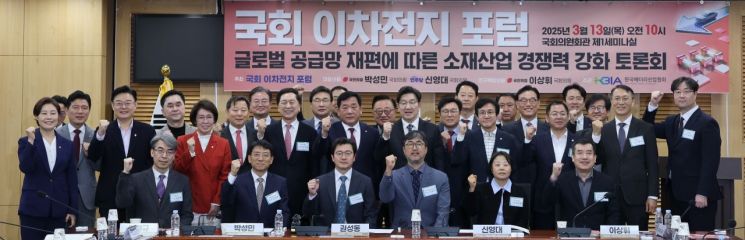 Group photo of the National Assembly Secondary Battery Forum. Provided by the Korea Battery Industry Association.
The event was attended by Park Sung-min of the People Power Party, Shin Young-dae of the Democratic Party, Lee Sang-hee of the People Power Party, as well as Park Jae-beom, Senior Researcher at POSCO Research Institute, and Lee Jung-doo, PD of Secondary Battery at the Korea Institute for Industrial Technology Planning and Evaluation.
On this day, representatives from the Korea Battery Industry Association and battery materials companies made proposals regarding amendments to the Restriction of Special Taxation Act, production subsidies, temporary investment tax credits, and industrial electricity rates. Under current law, companies can only receive tax credits if they generate operating profits. The industry argues that due to the electric vehicle chasm (Chasm: temporary demand stagnation), which has caused massive losses, a direct refund system should be introduced to provide cash support equivalent to the tax credit even if there is no profit, and the law should be amended to allow unused tax credits to be transferred to third parties.
Senior Researcher Park Jae-beom analyzed that Korea’s secondary battery industry is very vulnerable in supply chain competitiveness from raw materials to materials. He emphasized, “Domestic material companies in the anode material, electrolyte, and separator sectors are struggling with less than 5% global market share,” and stressed, “It is urgent to provide production subsidies for supply chain economic security items and to implement exceptional policies such as temporary electricity fee reductions.”
PD Lee Jung-doo also mentioned the large-scale investments by the Chinese government and companies, stating, “Without active government-level research and development (R&D) support, it will be difficult for Korea to continue leading the global battery industry in the future,” and emphasized, “An increase in R&D budgets for cost reduction technologies such as dry electrode processes and new markets is necessary.”
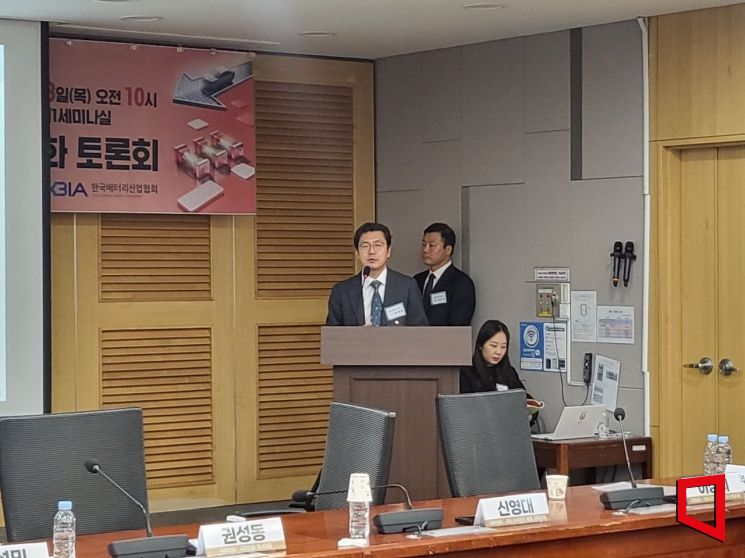 On the 13th, Park Jaebom, Senior Researcher at POSCO Research Institute, is giving a presentation on "Current Status of Battery Material Companies and the Need for Support" at the National Assembly Members' Office Building. Photo by Shim Sunga
Choi Jong-seo, Executive Director of the Korea Battery Industry Association, appealed, “I earnestly ask the National Assembly and government to prioritize reviewing measures so that our companies can secure sustainable management and continue generous investments in the future.”
Regarding the recently announced 50 trillion won advanced strategic industry fund by the government, Executive Director Choi said, “To ensure effectiveness for domestic companies, the door should be opened for investments in overseas factories or mines.” He added, “Although we are receiving significant help through the supply chain stabilization fund, most of it is operated in the form of loans. If it is restructured to allow broader use such as equity investments in companies facing investment capacity limits, it could become a more effective support measure.” Additionally, Executive Director Choi requested R&D budget support and activation of domestic company supply chains.
Individual materials company representatives also requested support policies tailored to their respective company circumstances. Han Mi-hyang, Director at POSCO Future M, said, “If China dominates the supply chain, situations like the ‘urea crisis’ will occur,” and stressed, “Production subsidies are urgently needed for domestic companies running deficits to sustain their investments.” Anode materials, which mainly use graphite, currently have China occupying 94% of the global market. Since China is included in the Foreign Entities of Concern (FEOC) under the Inflation Reduction Act (IRA) deferred by the U.S. until 2026, POSCO Future M, the only domestic anode material producer, feels a strong sense of crisis.
Lee Sang-geun, Head of Planning at Korea Zinc, criticized industrial electricity rates. He said, “We planned to build an electrolytic copper foil plant with a capacity of 13,000 tons in Ulsan and expand it to 60,000 tons, but electricity rates have doubled in the meantime,” and lamented, “Electrolytic copper foil is made through electrolysis, and most processing costs are electricity fees, which are too expensive, so we are considering overseas expansion.” He also said, “Although we are a large company, our subsidiaries engaged in secondary battery materials have small scale and sales,” and requested, “Please include large companies in the sunset clause for temporary investment tax credits.”
Advisor Koo Hoe-jin and Lee Sang-eun, Vice President of KJ International, a subsidiary of Geumyang, also emphasized the need for expanding the scope of national power technology tax credits, direct refund systems, and support for decoupling from China.
In response, National Assembly and government officials said they would consider various support measures to foster the domestic battery industry. Kim Tae-hoon, Supply Chain Response Officer at the Ministry of Economy and Finance, said, “Supply chain stability is a core national economic security task, but more importantly, it is directly related to the survival and growth of companies,” and added, “We will work to create a national supply chain ecosystem in step with corporate efforts.” Regarding the direct refund system, he said, “We will consult with the Ministry of Economy and Finance’s Taxation Office.”
Kim Jong-joo, Director of Industrial Supply Chain Policy at the Ministry of Trade, Industry and Energy, said, “We will strive to expand practical policy support so that Korea’s battery materials industry can strengthen its competitiveness amid global supply chain restructuring.”
Assemblyman Shin Young-dae said, “I sympathize with the battery industry’s position that there is no benefit in reducing corporate tax when they are not in a position to pay taxes,” and stated, “Even if full direct refund system implementation is difficult, we will push for legislation including partial refunds within the scope of national finances. We will take the lead in preparing a comprehensive support package encompassing tax benefits, regulatory improvements, and financial support.”
© The Asia Business Daily(www.asiae.co.kr). All rights reserved.












