Agreed to Manipulate Net Number Portability Changes
to Adjust Sales Incentives
SK Telecom, KT, and LG Uplus, the three companies dominating the domestic mobile telecommunications market, were fined a provisional penalty of 114 billion KRW by the Fair Trade Commission on the 12th for colluding to manipulate net number portability increases and decreases to secure sales incentives. The Fair Trade Commission judged that they colluded on key business information for seven years to avoid competition in number portability and to increase profits.
According to the Fair Trade Commission, after these three companies were sanctioned by the Korea Communications Commission in December 2014 for violating the Device Distribution Act by providing excessive sales incentives, they operated a so-called 'Seocho-dong Situation Room' together with the Korea Association for ICT Promotion (KAIT), pledging to self-regulate.
At this situation room set up in an officetel in Seocho-dong, employees from the three companies and KAIT met daily from November 2015 to September 2022 to share each company's number portability status and sales incentive levels, and to sanction cases where a specific carrier was found to be providing excessive sales incentives.
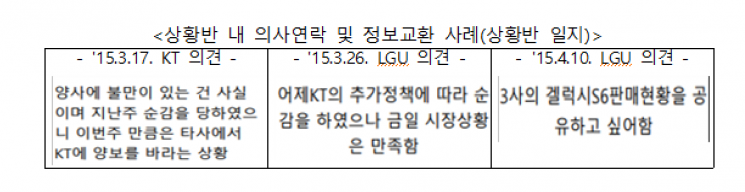
The three companies executed agreements to adjust the net number portability increase or decrease counts by mutually agreeing to raise or lower sales incentives when net increases or decreases were disproportionately concentrated on a specific operator.
Specifically, when one carrier's net number portability increase continued to rise, it would lower its own sales incentives, or other carriers experiencing net decreases would raise their sales incentives together. Conversely, when net decreases increased, carriers with net increases would mutually agree to lower their sales incentives or allow the carrier with net decreases to raise theirs.
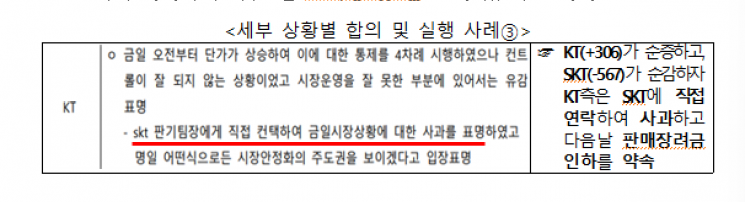
During the investigation, the Fair Trade Commission also discovered conversations where a KAIT official who was present in the situation room explained to subordinates that a 'mutual net increase and decrease pact' existed among the three companies and that implicit collusion had been ongoing for a long time. Internal documents also revealed that a sales manager from a carrier with a large net increase in number portability directly contacted and apologized to the manager of a carrier with a net decrease. It was also confirmed through work records of KAIT employees participating in the situation room that when a carrier with net decreases was unable to respond due to internal circumstances, other carriers collectively lowered their sales incentives.
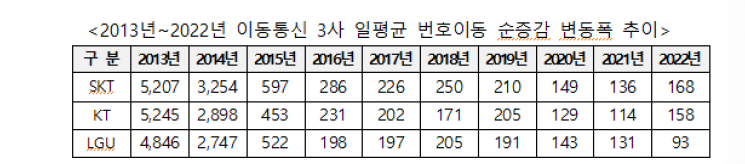
As a result of this collusion, the Fair Trade Commission pointed out that the average daily net number portability increase or decrease among the three companies shrank from about 3,000 cases in 2014 to within 200 cases in 2016. The total average daily number portability cases decreased by 45.7%, from 28,872 cases in 2014 to 15,664 cases in 2016, and continued to decline to 7,210 cases in 2022.
The Fair Trade Commission judged that this collusion by the three companies increased consumer burdens and distorted fair competition in the market. It considered this a violation of Article 40, Paragraph 1, Item 3 of the Monopoly Regulation and Fair Trade Act, which prohibits 'restrictions on transactions of goods or services between business operators.' Of the 114 billion KRW penalty imposed on the three companies, SK Telecom, KT, and LG Uplus were fined 42.662 billion KRW, 33.029 billion KRW, and 38.334 billion KRW respectively. This amount was calculated based on sales during the period of the violation, and the penalty may be increased or decreased after the related sales amount is finalized.
Moon Jae-ho, head of the Cartel Investigation Bureau at the Fair Trade Commission, said, "Competition to attract number portability subscribers was restricted, resulting in reduced monetary and non-monetary benefits that consumers receive when switching to another carrier."
The Fair Trade Commission stated, "This case uncovered collusion among the three mobile carriers over seven years, and by revitalizing competition in the mobile telecommunications market, it is expected to reduce household communication expenses."
Excluding MVNOs (Mobile Virtual Network Operators), the three carriers hold an 89% market share (SKT 48.4%, KT 28.5%, LG Uplus 12.1%), dominating the domestic mobile telecommunications market.
Meanwhile, the three carriers claim that they only followed the Korea Communications Commission's enforcement to comply with the Device Distribution Act and deny any collusion, stating they will pursue legal procedures after receiving the Fair Trade Commission's decision document.
© The Asia Business Daily(www.asiae.co.kr). All rights reserved.














