Essential Consumer Goods Stocks Attract Attention for Their Resilience to Economic Cycles
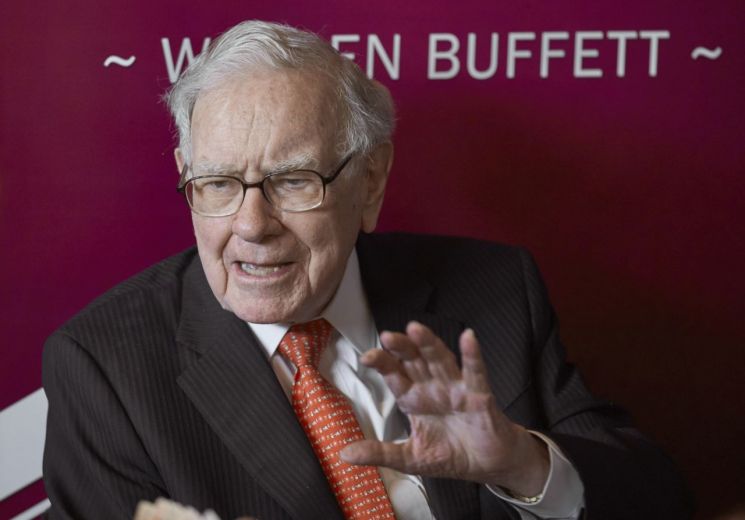
Warren Buffett Increases Food Stock Holdings Ahead of U.S. Market Crash
As fears of a recession originating from the U.S. sweep through the domestic stock market, food stocks have attracted attention by successfully defending their share prices.
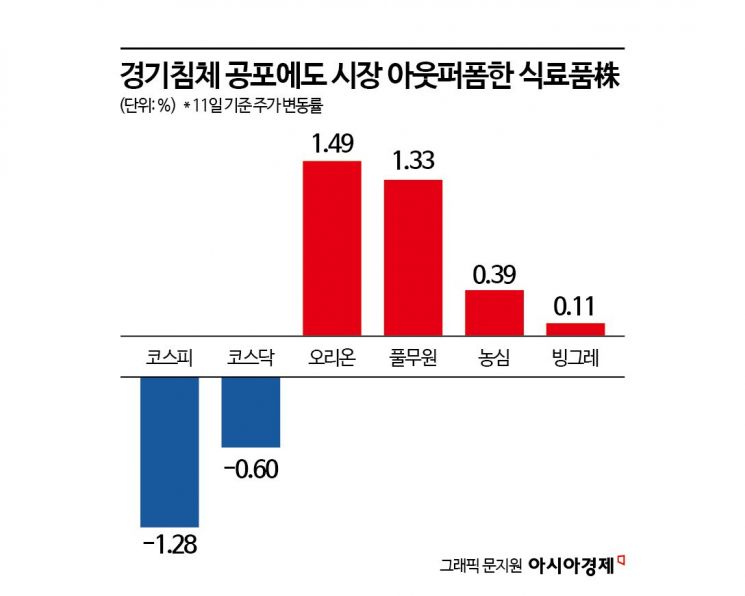
According to the Korea Exchange on the 12th, the KOSPI closed at 2,537.60, down 1.28% from the previous day. The KOSDAQ also ended slightly lower, down 0.60%. This followed a sharp plunge in the New York stock market after U.S. President Donald Trump stated his intention to push forward with tariff policies despite the risk of a recession. Among the 2,667 stocks listed on the KOSPI and KOSDAQ, 1,902 stocks declined.
On the other hand, food stocks showed resilience and outperformed the market despite widespread sell-offs. Pulmuone, which had fallen more than 4% early in the session, narrowed its losses and closed up 1.33%. Binggrae, which started down 2%, also rebounded by 0.11% thanks to buying from foreign and institutional investors. Orion closed at 109,200 KRW, up 1.49%, approaching a 52-week high.
As fears of a recession ('R' for Recession) rapidly spread due to concerns that President Trump's tariff hikes will cause inflation, reduced consumption, decreased corporate investment, and slower growth, essential consumer goods such as food have gained attention in the market. Food products are considered representative defensive stocks because their demand is price inelastic like daily necessities and their stock prices are less sensitive to economic cycles. Recently, Warren Buffett, known as the 'Oracle of Omaha,' attracted attention by increasing his cash holdings to a record high (about 480 trillion KRW) while expanding stakes in liquor and pizza companies, seemingly anticipating a U.S. recession and stock market crash.
The global expansion of K-Food, led by Samyang Foods' 'Buldak' (Hot Chicken Flavor Ramen), is also a positive factor for food stocks. Hyunjung Son, a researcher at Yuanta Securities, emphasized, "Binggrae is achieving clear results in the global market with 'Melona.' In the U.S., Melona has entered all Costco stores, establishing itself as the unrivaled number one Korean ice cream brand, accounting for about 70% of the Korean ice cream market in the U.S." Orion, which controls 70% of the Russian Choco Pie market, could benefit from cost reductions if exports to Europe resume following the end of the Ukraine conflict and the stabilization of the ruble.
Stabilization of grain prices and improved profitability through product price increases are also expected. Nongshim recently decided to raise the domestic prices of 17 products (14 ramen varieties and 3 snack types), including Shin Ramyun and Shrimp Crackers, by an average of 7.2% for the first time in two and a half years since September 2022. Taehyun Kim, a researcher at IBK Investment & Securities, stated, "Considering that the products subject to price increases account for about 71% of sales and that export products to Europe and Southeast Asia are excluded, this price hike is expected to increase domestic sales by about 78 billion KRW and operating profit by 27 billion KRW this year." He projected Nongshim's consolidated sales and operating profit for this year to rise 8.7% and 30% year-on-year to 3.7372 trillion KRW and 211.9 billion KRW, respectively.
Researcher Son analyzed, "Demand in the food and beverage sector is expected to grow both overseas and domestically by 2025. In particular, the expansion of distribution channels in the U.S. and the effects of China's government stimulus measures are expected to drive continued export growth."
© The Asia Business Daily(www.asiae.co.kr). All rights reserved.