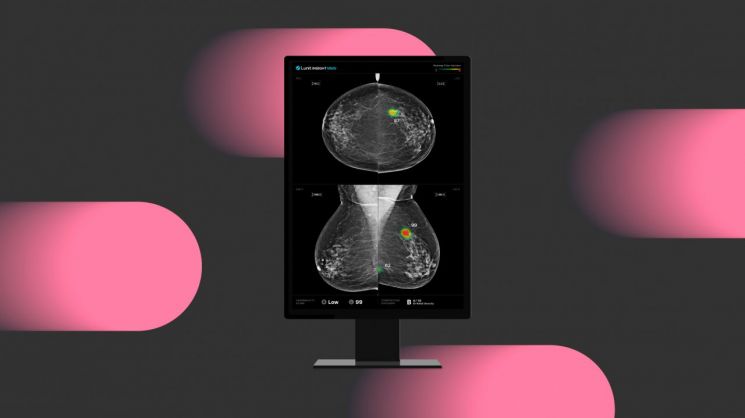
Medical AI company Lunit announced on the 10th that the results of a large-scale multicenter prospective study using Lunit Insight MMG, an AI imaging analysis solution for mammography, have been published in the international journal Nature Communications (IF 14.7).
This study is the world's first large-scale prospective study to verify the effectiveness of AI in a 'Single Reading' environment, where one radiologist interprets mammograms, as is common in countries like Korea and the United States. It demonstrated that AI improves diagnostic accuracy without increasing unnecessary re-examinations.
Led by Professor Jang Yun-woo of the Department of Radiology at Soonchunhyang University Seoul Hospital and Professor Ryu Jeong-gyu's team at Gangdong Kyung Hee University Hospital, the study was conducted from February 2021 to December 2022 involving 24,543 women aged 40 and above who underwent national health screening at six university hospitals in Korea (Soonchunhyang University Seoul Hospital, Gangdong Kyung Hee University Hospital, Nowon Eulji University Hospital, Konkuk University Hospital, Inje University Busan Paik Hospital, and CHA University Bundang CHA Hospital).
The research team compared the results of mammogram readings performed solely by breast radiology specialists with those assisted by AI, followed by a one-year follow-up examination.
As a result, the Cancer Detection Rate (CDR) when using AI-assisted reading was 5.7 per 1,000 individuals, a significant 13.8% increase compared to 5.0 per 1,000 without AI. Notably, the Recall Rate (RR), which refers to the rate of patients called back for additional cancer re-examination, was not affected. This indicates that AI can effectively increase breast cancer detection rates without increasing unnecessary re-examinations.
Additionally, the team conducted further simulation studies confirming that when general radiologists use AI, the breast cancer detection rate increases from 3.9 to 4.9 per 1,000, a 26.4% rise. AI was also found to significantly detect additional early-stage breast cancers that are smaller than 20 mm or without lymph node metastasis.
Professor Jang Yun-woo, the lead author of the study, explained, "Through this study, we confirmed that using AI in a 'Single Reading' mammography environment can increase breast cancer detection rates not only for experienced breast radiologists but also for general radiologists with less reading experience, and that AI can contribute to the early diagnosis of breast cancer."
Seobum Seok, CEO of Lunit, stated, "This large-scale prospective study conducted in a single reading environment has demonstrated the practical diagnostic effectiveness of Lunit's AI solution for breast cancer. This provides important evidence for utilizing Lunit's AI solution in countries like Korea and the United States, where a single physician reads mammograms independently."
Meanwhile, this study was supported by the Korea Health Industry Development Institute, and the research team plans to publish the final analysis results of the two-year follow-up examination after 2026. Future research will analyze the impact of AI use on interval cancer occurrence and screening-detected cancer detection within national cancer screening programs that conduct breast cancer screening every two years, evaluating the potential of AI utilization in breast cancer screening environments.
© The Asia Business Daily(www.asiae.co.kr). All rights reserved.












