Despite a Year Off in Protest, No Apology or Promise to Withdraw the Increase from the Government
Concerns Over Whether Proper Education Is Possible Due to Doubling of 2024 and 2025 Classes
"We are also victims, so why are you holding us responsible?" "We worked hard to get here, but it is the government that made us reconsider our career paths." "Once trust is broken, it is hard to restore."
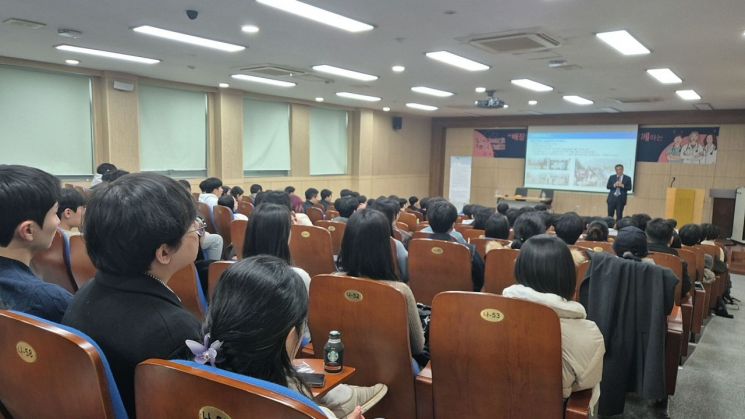 On the 8th, medical students and residents attended Professor Bae Jang-won's lecture at the seminar "The Path of a Doctor, Prescribing Hope" held at Seoul National University of Education. Photo by Choi Tae-won
At the seminar titled 'Prescribing Hope for the Path of Doctors' held on the 8th at Seoul National University of Education in Seocho-gu, Seoul, hosted by the National Union of University Parents (Jeonuihakyeon), medical students expressed these sentiments.
The event was bustling with about 100 students gathered from across the country, despite it being a Saturday evening, possibly because it was right after the government's announcement that if medical students return to classes by the end of this month, the number of medical school admissions next year would be reverted to the pre-increase level.
Professor Bae Jang-hwan, former professor at Chungbuk National University Hospital (Good Samsung Hospital), who took the stage, shared his past experiences and advised that the current medical policy conflict phase should be seen as a time to "make autonomous decisions and grow into true experts," but the students could not hide their troubled expressions.
A 24th class student currently on leave from a metropolitan area medical school said, "From the moment we entered university, we have faced confusion having to reconsider the career path we chose even before starting our studies due to the increase in medical school admissions and changes in medical policies," adding, "Some schools have students repeating a year and not receiving tuition refunds, suffering damages, but please do not blame us as if we are responsible for this situation."
A second-year student on leave from a medical school in the Honam region said, "I used to study thinking I would naturally become a clinical doctor, but now I am constantly worried about which career path to choose in the future."
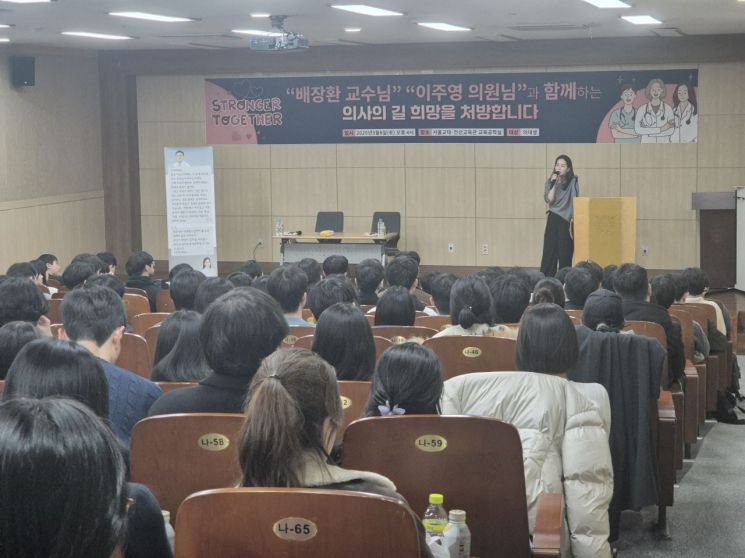 On the 8th, medical students and residents listened to Lee Ju-young, a member of the Reform New Party, at the seminar "The Path of Doctors, Prescribing Hope" held at Seoul National University of Education. Photo by Choi Tae-won
Students also expressed concerns that even if the 26th class admissions increase is temporarily set to 'zero,' there is a possibility of resuming increases from the 27th class onward.
Another 24th class medical student said, "What we are demanding now is not just freezing the quota but improving the medical training environment and withdrawing the 'Essential Medical Package' policy," adding, "Since trust in the government is already broken, it is difficult to fully accept the policy to reset the admissions increase on the premise of returning to classes."
Some freshmen this year said that even if they want to attend classes, they cannot help but be cautious as their seniors have not returned yet.
A parent of a medical student said, "The 25th class is already discouraged because they benefited from the admissions increase, but they are not free from the unique culture of medical schools such as apprenticeship-style education and close senior-junior relationships," explaining, "It is impossible to go against collective action unless seniors and residents return first."
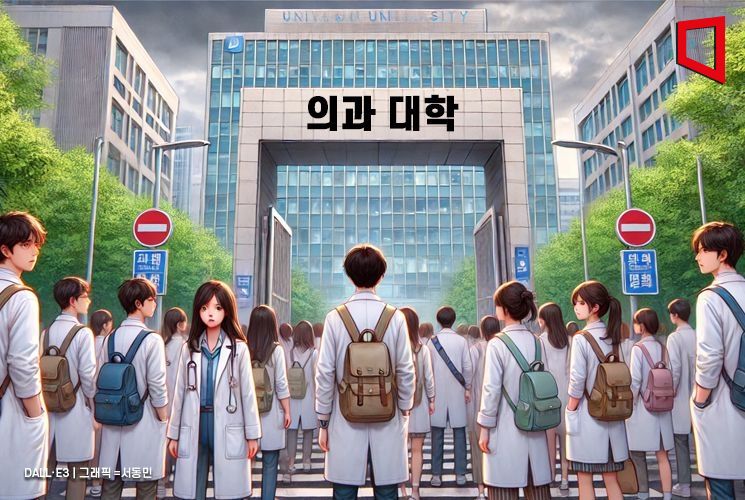
Another parent said, "The academic operation model proposed by the government and universities to resolve the 'doubling problem' of having to teach the 24th and 25th classes simultaneously ultimately means compressing the curriculum to graduate faster," adding, "As a parent, I want my child to return to classes and study now, but I agree that becoming a doctor without receiving sufficient quality education is undesirable both personally and socially, so I will support whatever decision is made."
© The Asia Business Daily(www.asiae.co.kr). All rights reserved.














