Jay Gambetta, Vice President, Attends Yonsei Quantum Week
"Korea Started Late in Quantum Research, But Developing Rapidly"
"IBM to Unveil Fault-Tolerant Quantum Computer Within Four Years"
A senior executive overseeing IBM's quantum computing division expressed confidence that the first 'fault-tolerant' quantum computer will be seen within four years. The plan is to elevate commercialization to the stage where the system can correct its own errors, thereby achieving Quantum Advantage. First, IBM plans to unveil a hybrid supercomputer combining high-performance computing (HPC) and quantum computing in the second half of this year.
IBM also emphasized its collaboration with Korea. It has already introduced the quantum computer 'IBM Quantum System One'?to be used in scientific and technological research?in Korea for the first time, in partnership with Yonsei University. Regarding Korea's level of quantum computing, IBM evaluated that "although the start was somewhat delayed, it is developing at a very rapid pace."
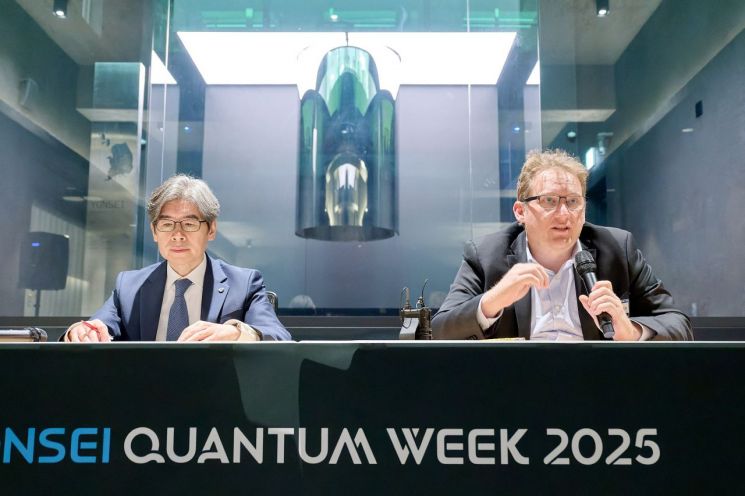 From the left, Jeong Jae-ho, Director of the Quantum Business Group at Yonsei University, and Jay Gambetta, Vice President of IBM, are meeting with reporters and answering questions on the 7th at the Quantum Computing Center, Yonsei University International Campus in Songdo, Incheon. Photo by IBM
Jay Gambetta, IBM Quantum Senior Researcher and Vice President, shared this vision with reporters on the 7th at the Quantum Computing Center on Yonsei University’s International Campus in Songdo, Incheon. When asked about IBM’s development and market strategy, he said, "Our strategy is to continuously upgrade by advancing algorithms."
He added, "By around 2029, according to our plan, we will have the first quantum computer with inherent fault tolerance. If we can demonstrate quantum advantage by then, we will be able to present concrete plans and directions for how to commercialize quantum computing technology going forward."
The biggest challenge currently facing the quantum computing industry is 'errors.' This problem arises from the fundamental nature of quantum mechanics and the randomness involved in calculations. Because the information input into qubits (the computational units) is vulnerable to external environmental and operational influences, as the scale of computation grows, errors increase as well. The 'fault tolerance' mentioned by Vice President Gambetta refers to the stage where the quantum error correction (QEC) challenge has been solved. Once the error problem is resolved, quantum computers are expected to be more widely utilized across industries.
Gambetta also reiterated the plan to announce the 'hybrid computer' in the second half of this year. IBM intends to unveil a 'quantum-centric supercomputer' that combines classical supercomputers with quantum computers. IBM explains that this will be a more stable and efficient computing resource.
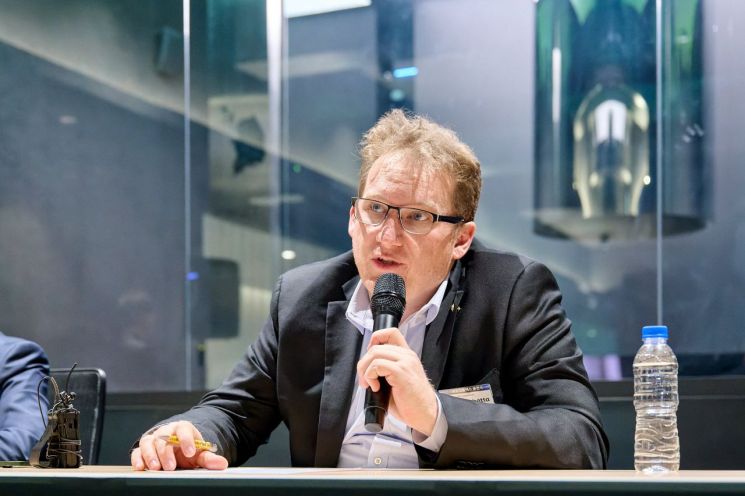 Jay Gambetta, Vice President of IBM, is answering questions from reporters on the 7th at the Quantum Computing Center, Yonsei University International Campus, Songdo, Incheon. Photo by IBM
Regarding the 'Korean market,' he offered a positive outlook. When asked, "Korea is also making government-level investments, but there are no visible results yet, right?" he responded, "Although the start was somewhat delayed, it is growing rapidly and catching up quickly. I hope to see many research projects in Korea realizing the use of quantum computers in areas such as materials and biophysics."
When asked about the 'tasks Korea needs for quantum computer development,' he diagnosed, "The most important thing for Korea is to focus on algorithm research." He continued, "After IBM and Yonsei University installed the quantum computer 'IBM Quantum System One' in Korea, its usage has grown quite rapidly and is already at full capacity. This level of utilization means that Korea is ready to embark on full-scale algorithm research."
Gambetta expressed encouragement, saying, "I expect more visible results to emerge from Korea in the near future. Korean startups are already achieving initial successes, such as developing chemistry-related solutions through quantum computing research. Personally, I believe the potential of the Korean market is truly great." He added, "Algorithm research will be further activated through the use of hybrid computers."
© The Asia Business Daily(www.asiae.co.kr). All rights reserved.













