Number of Illegal Road Training Cases Triples in Four Years
No Safety Guarantees or Accident Compensation for Drivers
Proliferation of Agencies and Ambiguous Regulations Hamper Crackdowns
Unauthorized instructors continue to provide driving training despite safety concerns. Private companies boldly continue marketing online, but due to the absence of related penalty regulations, proper crackdowns are not being conducted.
According to the National Police Agency on the 10th, the number of illegal road training cases by unregistered instructors last year was 117, more than triple the 38 cases in 2020. Under the Road Traffic Act, it is prohibited for anyone not affiliated with a police-approved driving school to provide paid driving education. Violators face up to two years imprisonment or fines up to 5 million won.
However, since training is possible with unlicensed personal vehicles and costs only about half of that at driving schools, these operations still run covertly. Searching keywords related to driving training on portal sites like Naver and Google easily exposes websites of private driving training agencies. These agencies cannot use names like "driving school," so they use business names that evoke driving, such as "Drive" or "Driving." Mr. Park (31), who recently took private driving training, said, "When I searched for driving training, these sites appeared before official driving schools, and their websites were well-made, so I didn’t realize it was illegal."
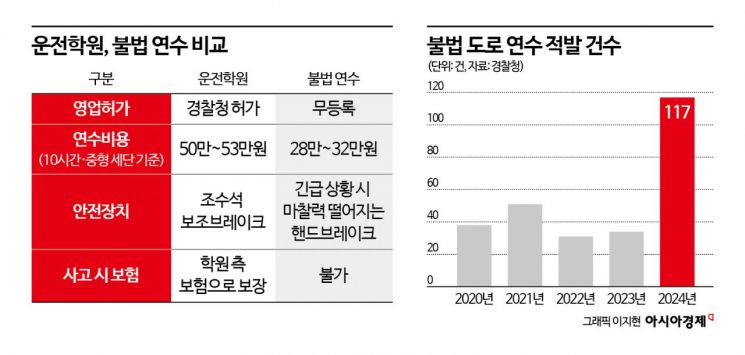
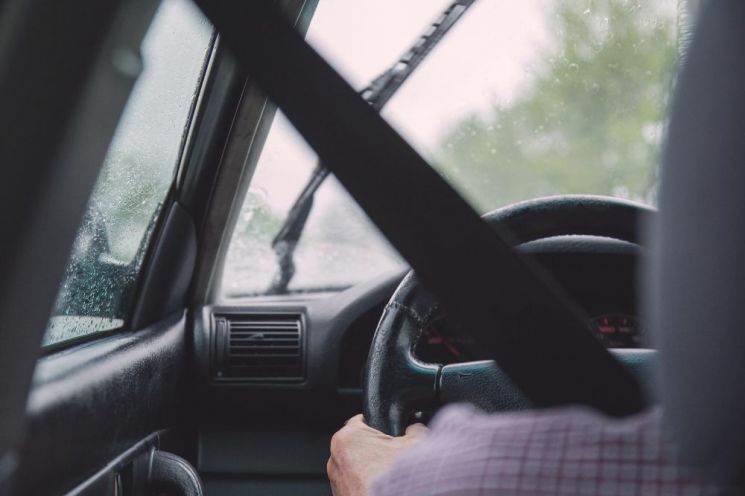
Unlike official driving schools, private training often fails to guarantee the safety of trainees or provide compensation in case of accidents. Unlike the yellow training vehicles of driving schools equipped with a separate brake on the passenger seat, private training vehicles typically only have a 'hand brake' operated manually by the driver, making it difficult to respond to sudden situations. Since driver insurance does not apply, trainees are likely to bear responsibility in property or personal injury accidents.
These are unregistered businesses not reported to the National Tax Service, thus evading taxes. In fact, when the reporter accessed several agency websites, legally required information such as business registration numbers, business addresses, and representative names were missing.
Despite these issues, enforcement is difficult. The regulations for cracking down on or punishing driving training agencies or recruitment firms are vague. A police official said, "Until now, during investigations of unregistered driving instructors, driving training agencies had to be booked as accomplices. Ultimately, because there are no regulations on driving training agencies, their promotions are widespread," adding, "If penalty regulations for driving training agencies are established, there will be room for active investigations." According to the National Assembly’s legislative information system, a related partial amendment to the Road Traffic Act was proposed for the first time in this National Assembly but has not passed the parliamentary hurdle.
The police are seeking ways to improve driving school services to prevent trainees from flocking to illegal private agencies. At the end of last year, the National Police Agency conducted a pilot program nationwide for road training using trainees' own vehicles. The police stated, "As illegal agencies increase, the road training environment deteriorates," and "We are preparing various measures to eradicate illegal road training."
© The Asia Business Daily(www.asiae.co.kr). All rights reserved.













