More K-Startups Eye Entry into the Indian Market
BalanceHero and BlimongKids Achieve Notable Success Locally
India has emerged as a new land of opportunity for domestic entrepreneurs. India is a huge market dreaming of being the ‘post-China’ with an economic growth rate of over 7%, attracting capital from around the world. The remarkable success stories of K-startups targeting the Indian market have also increased the appeal of this market. Considering the intense competition in the domestic market and the saturation of IT services, India, which is easy to expand globally, is expected to become a stage for domestic entrepreneurs to take on new challenges.
According to the Korea Institute of Startup & Entrepreneurship Development on the 7th, the competition rate reached 6 to 1 after recruiting domestic startups to participate in the startup exhibition ‘Startup Mahakumbh 2025’ hosted by the Federation of Indian Chambers of Commerce and Industry (FICCI). Eight startups within seven years of establishment were publicly recruited, attracting 47 applicants. Considering that the recruitment period was short as it was held at the end of last month, the Korea Institute of Startup & Entrepreneurship Development explained that domestic startups showed strong interest.
The exhibition will be held in New Delhi, India, from the 3rd to the 5th of next month and is regarded as the optimal stage for startups to showcase their businesses to the Indian market. Last year, the first event, Indian Prime Minister Narendra Modi, local dignitaries, about 48,000 visitors, and approximately 1,300 exhibiting companies participated. This year, the organizers expect about 3,000 companies and 50,000 visitors to attend.
The increased interest of startups is influenced not only by the growth potential of the Indian market but also by the increasing number of domestic entrepreneurs succeeding locally with innovative technologies and services. BalanceHero, founded by CEO Cheolwon Lee, is a representative example. The company officially started its business in India in 2016 with the prepaid telecom recharge service ‘True Balance,’ specialized for the local market, and currently has about 85 million users. Since 2019, it has expanded its business by providing microloans to low-credit users through its self-developed alternative credit scoring system. Its sales and loan execution volume in the first half of last year grew sharply, recording 66.7 billion KRW and 340 billion KRW respectively, more than doubling compared to the same period the previous year.
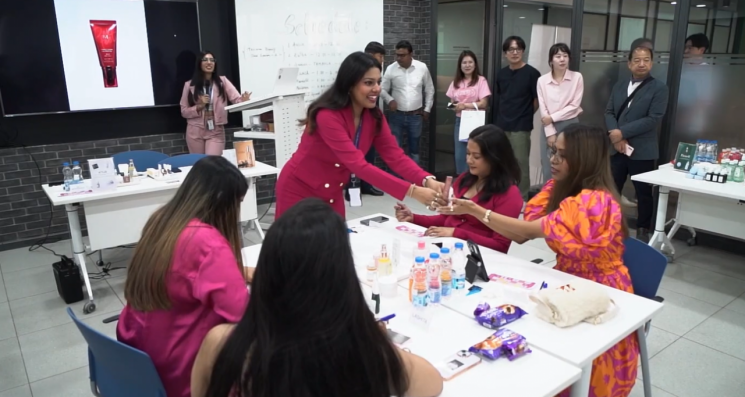 At the 'Macaron Beauty Class,' operated once every six months by Blymonkeys, local Indian influencers and beauty artists are learning makeup techniques and know-how tailored to K-beauty trends. Photo by Blymonkeys
BlimongKids, which entered the Indian market in 2019, is also active locally with the K-beauty e-commerce platform ‘Macaron.’ Macaron is a business that accurately targets the growing interest in K-beauty in India. According to KOTRA, the K-beauty market in India is expected to grow at an average annual rate of 9.4% until 2026. Macaron has introduced about 380 K-beauty brands and 18,000 products to Indian consumers. The monthly active users exceeded 1.2 million. In particular, the self-developed AI-based hygiene approval system automated document review and error detection, shortening the processing time for the essential hygiene approval certification (CDSCO) required for entry into India, which enhanced product competitiveness. Thanks to this, last year’s sales increased by 209% compared to the previous year, reaching 33 billion KRW, the highest performance ever recorded.
Yoo Seungwan, CEO of BlimongKids, said, "In India, where the Hallyu boom is occurring among the young population accounting for more than 50% of about 1.5 billion people, Korean brands are now recognized as premium brands. It is a land of opportunity, but entering the market is not easy. Since culture and consumption patterns vary by age group and region, it is very important to build trust with consumers by understanding Indian consumers and regional characteristics and approaching with a long-term and step-by-step strategy."
© The Asia Business Daily(www.asiae.co.kr). All rights reserved.












