ECB Monetary Policy Meeting Scheduled for the 6th
Focus on 0.25 Percentage Point Rate Cut
Concerns Over Inflation Due to Tariffs and Increased Fiscal Spending
The European Central Bank (ECB), which has been aggressively cutting policy rates since last year, is scheduled to hold a monetary policy meeting on the 6th. The market is closely watching whether the ECB will maintain its previous stance described as ‘restrictive’ or revise it at this meeting. However, the impact of the Trump administration’s tariff policies and the expansion of European defense spending on inflation and the economy is difficult to predict, complicating the ECB’s calculations regarding interest rate policy.
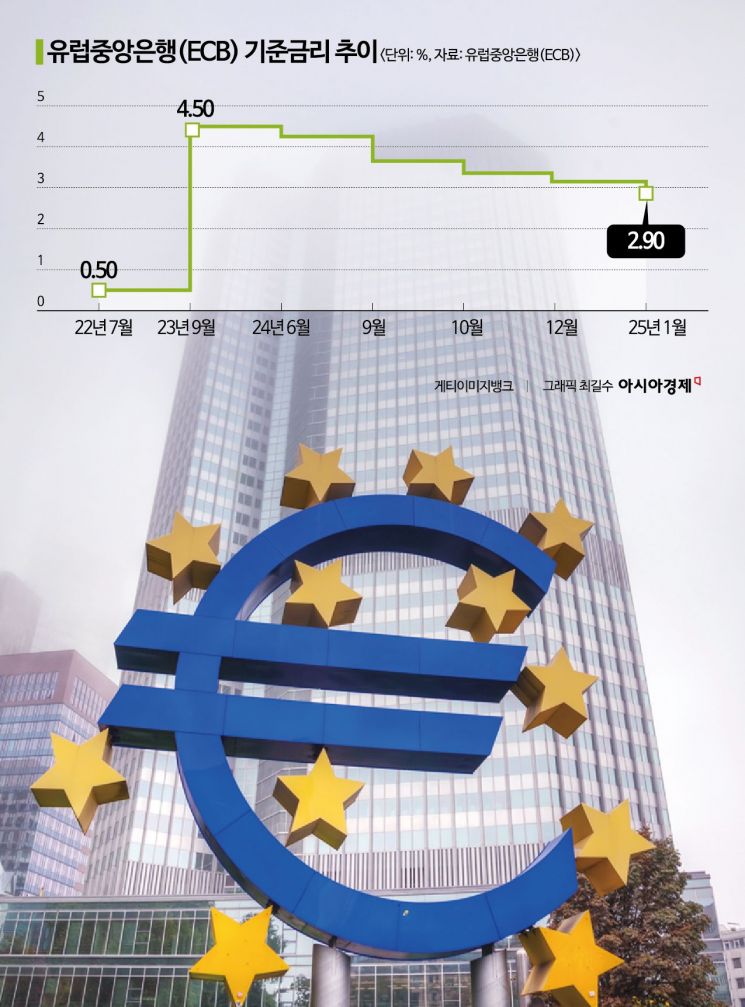
According to CNBC, the market expects the ECB to cut the policy rate by 0.25 percentage points at the monetary policy meeting on the 6th. If the prediction holds true, it would be the second rate cut this year. The ECB held its first monetary policy meeting last month and lowered the deposit rate from 3% to 2.75% per annum, and the main refinancing rate from 3.15% to 2.9% per annum. The marginal lending rate was also reduced from 3.4% to 3.15% per annum. Among these three policy rates, the ECB primarily bases its monetary policy on the deposit rate. The market expects the ECB to lower the deposit rate to around 2.0% per annum within the year, due to the poor economic conditions in major European Union (EU) countries such as Germany and France. While the U.S. Federal Reserve (Fed) has shifted to a policy of holding the benchmark rate steady, Europe is pushing forward with its existing rate cut policy.
The market anticipates that internal differences within the ECB regarding interest rate policy will widen after this meeting, due to the variables of ‘tariffs’ and ‘defense spending.’ Within the ECB, there are ongoing opinions that the pace of rate cuts should be moderated considering the possibility of inflation reigniting due to U.S. tariff policies. The concern is that higher tariffs could lead to a trade recession → economic slowdown, which would lower the value of the euro and raise import prices. Rising import prices could stimulate inflation.
The expansion of defense spending is also a factor that makes it difficult to hastily cut rates. EU member states have planned to spend an additional 650 billion euros (998 trillion won) on defense over four years to strengthen security, as relations with the U.S. have cooled during the Ukraine war peace negotiations. Increased liquidity in the market could stimulate inflation. Moreover, Germany’s next government has announced plans for large-scale fiscal spending aimed at economic stimulus.
Analysts at Bank of America (BoA) Global Research recently stated in a report that internal conflicts among policymakers are expected to intensify after this week’s ECB meeting, adding, "As disagreements grow, this will be the last ‘easy’ rate cut."
Thierry Wiseman, Global FX and Rates Strategist at Macquarie, also analyzed, "The broad movement related to European rearmament implies fiscal expansion, which will lead the ECB to reconsider the scope of future policy rate cuts."
The market’s focus is on whether the ECB will reflect these factors comprehensively and maintain its existing stance of being restrictive at this meeting. There is also interest in whether the ECB will mention the possibility of holding rates steady at the April meeting. Analysts at Citigroup noted, "Geopolitical changes could ultimately lead to expansionary fiscal policy, but in the short term, they are likely to strengthen arguments for monetary easing."
© The Asia Business Daily(www.asiae.co.kr). All rights reserved.












