A technology has been developed that can reduce indoor air quality measurement time from 48 hours to within 3 hours while securing high accuracy.
On the 5th, the Korea Research Foundation announced that a joint research team consisting of Professor Jaehee Jeong and researcher Hyunsik Ko from Sejong University and Professor Kijun Heo from Chonnam National University developed a technology that monitors the concentration of bacteria in indoor air with over 95% accuracy within 3 hours.
This technology was developed by combining high-concentration sampling technology for airborne microorganisms with machine learning-based image analysis technology.
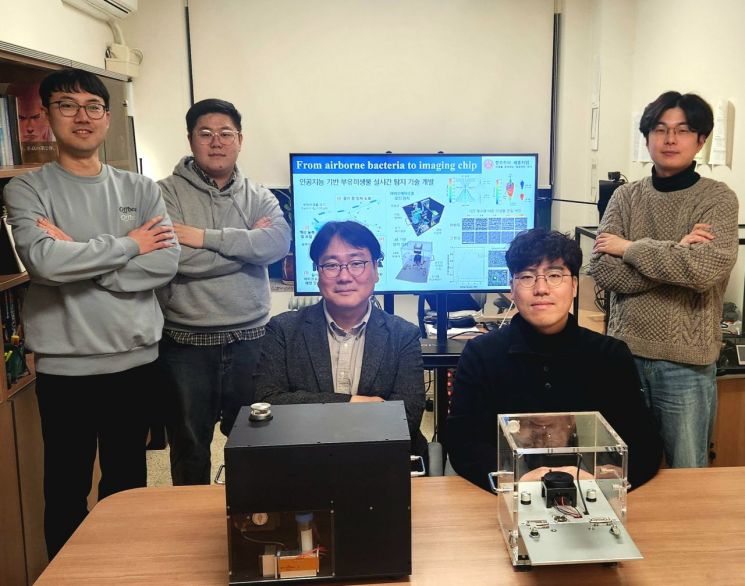 (From left) Sejong University researchers Jae-Hak Shin and In-Ho Kim, Professor Jae-Hee Jeong, Chonnam National University Professor Ki-Jun Heo, Yonsei University researcher Hyun-Sik Ko (former Sejong University). Provided by Professor Jae-Hee Jeong, Sejong University
Domestic indoor air quality management laws apply the "culture microbial colony counting method" recommended by the World Health Organization (WHO) as the standard test method. This test method involves collecting microorganisms in the air on a semi-solid nutrient medium and then culturing them for more than 48 hours to visually count the concentration of colonies that have grown.
While this method has the advantage of enabling accurate counting, it takes more than 48 hours (2 days) to measure indoor air quality and requires significant manpower (labor-intensive), which has been considered a drawback to overcome.
Various biochemical analysis-based technologies have been developed to solve these problems, but compared to the existing standard test method, they showed significant differences in results, making it difficult to apply them to the current system.
Accordingly, the joint research team embarked on developing a system that can drastically shorten detection speed by combining various technologies while still based on the standard culture method.
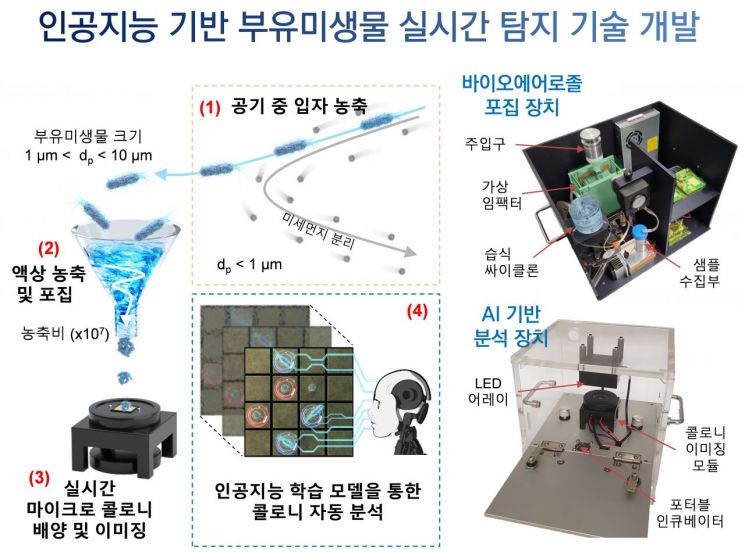 Overview of AI-based real-time detection technology for floating microorganisms. Provided by Professor Jeong Jaehee, Sejong University
First, to precisely detect the extremely low concentration of microorganisms in the air, they implemented a technology that uses the inertia of particles to continuously concentrate airborne bacteria up to 10 million times.
Also, through a sequential process of concentration in the air (primary) and concentration from air to liquid phase (secondary), they achieved world-class concentration performance.
Through this, the joint research team succeeded in measuring the colony-forming unit (CFU) concentration of bacteria in the air at the level of 30 CFU/㎥ with over 95% accuracy within 3 hours. CFU/㎥ refers to the number of colony-forming units per 1 cubic meter of air. The statistically valid effective range is 30 to 300 CFU/㎥, and culture plates with colony counts below 300 per 1 cubic meter of air may have errors in bacterial count measurement.
In particular, the system developed by the joint research team allows simultaneous culturing and high-resolution image generation in a portable incubator equipped with a compact microscope platform, enabling real-time microbial analysis without location constraints. Additionally, by utilizing machine learning-based image analysis technology, it has the advantage of real-time measurement of microbial community information.
Professor Jaehee Jeong said, “This technology is an automated system covering the entire process from sample collection to data analysis, integrating aerosol particle sampling technology, a microscope platform capable of large-area observation, and machine learning-based image analysis technology. Through this, it is evaluated as laying the foundation for developing equipment that can overcome the drawbacks of the existing standard culture method.”
Meanwhile, this research was conducted with support from the Nano Materials Technology Development Project and Basic Research Project promoted by the Ministry of Science and ICT and the Korea Research Foundation. The research results were published on the 1st in the international journal Sensors and Actuators B: Chemical.
© The Asia Business Daily(www.asiae.co.kr). All rights reserved.













