Budgets Difficult to Execute Are Cut in Supplementary Plans
Rapid Execution Rate Rises Even with the Same Spending
One Year’s Worth of Disability Benefits Spent at Once
"Only Focused on Achieving Numbers, Should Be Limited"
Local governments are using various loopholes to achieve rapid execution targets. They are cutting budgets that are impossible to execute altogether and significantly increasing easily spendable supplies. As the original goal of rapid execution to stimulate the economy fades, there are calls to improve the system.

Local Governments Cut Budgets as Rapid Execution Fails
According to the 'Rapid Execution Promotion Plan' documents obtained by Asia Economy on the 6th from several cities, counties, and districts, some local governments devised trick methods to achieve the assigned rapid execution rate. Rapid execution is a kind of reinforcement measure to boost the economy by concentrating budget spending in the first half of the year. This year, the government set the highest-ever rapid execution plans with 67% for the central government and 60.5% for local governments.
The most commonly used trick by local governments is budget cuts. The rapid execution rate is calculated by comparing the actual 'execution amount' to the total 'target amount.' Increasing the execution amount as much as possible is the best method, but if not feasible, they reduce the target amount. Then, even if the spending remains the same, the rapid execution rate indicator improves. Since the Ministry of the Interior and Safety's evaluation criteria are based on ratios rather than amounts, there is no issue.
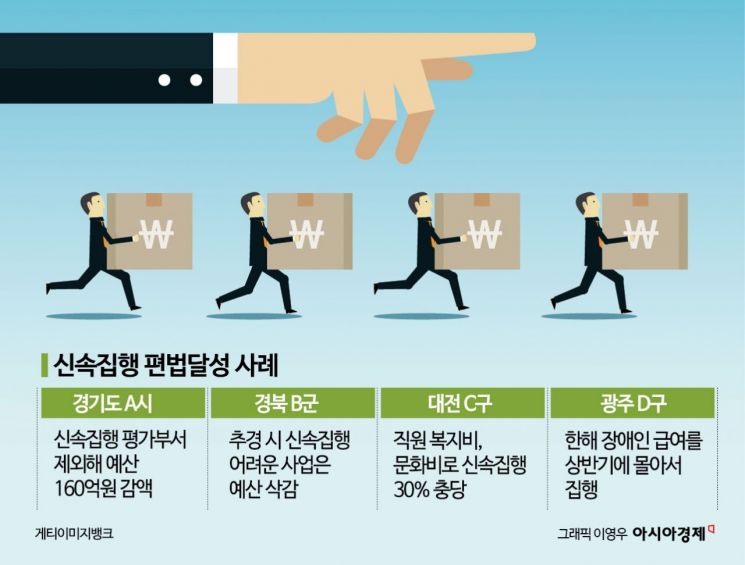
City A in Gyeonggi-do used this blind spot to reduce the rapid execution target amount at the end of last month. Originally, the goal was to rapidly execute 365.3 billion KRW in the first half, but it was reorganized to 349.3 billion KRW by cutting 16 billion KRW. They excluded departments subject to rapid execution evaluation. County B in Gyeongsangbuk-do decided to separately investigate the executability of projects when preparing the supplementary budget (Chugyeong). If projects that are difficult to execute are found, they plan to cut the budget to reduce their share in the target amount.
Local government officials agree that most local governments reduce budgets considering rapid execution, except for the Ministry of Economy and Finance and the Ministry of the Interior and Safety. According to a survey disclosed by the National Federation of Local Government Officials' Unions at a National Assembly forum on August 27 last year, among 1,508 officials, 43.4% answered "strongly agree" to the question "Do you think intentional under-budgeting of the main budget occurs?" Including those who generally agree, 68.6% evaluated that budget cuts for rapid execution exist.
One Year’s Worth of Disability Benefits Spent at Once
Conversely, there is also a method of significantly increasing budgets in sectors where rapid execution is easy. By advancing spending on chairs, supplies, and even official vehicles to the first half, the rapid execution rate can be raised. It is customary to execute internal staff allowances and welfare expenses as quickly as possible. Similarly, resident benefits and various support funds, which hardly generate unused funds even without rapid execution, must be spent as much as possible in the first half to receive good scores on rapid execution indicators, even if they have little effect on economic stimulation.
As a result, the departments responsible for internal management, rather than economic or construction departments, play the biggest role in rapid execution. District C in Daejeon spent 16.1 billion KRW out of the 54 billion KRW rapid execution target in the first quarter in the bureau responsible for autonomous administration. This means that departments handling staff welfare, resident registration, and cultural activities are responsible for about 30% of rapid execution. In contrast, departments such as economy (4.9 billion KRW) and construction (8.6 billion KRW), which have a real impact on Gross Domestic Product (GDP), had smaller rapid execution amounts.
Using tricks together can maximize rapid execution performance. District D in Gwangju had the highest rapid execution rate among local governments in 2021 at 157.8%. This was thanks to spending the entire 28.9 billion KRW disability activity allowance in the first half and pouring 72% of the 43.3 billion KRW infant care support fund. However, looking at the spending details, it is close to deception. This budget was received by related organizations, not directly by the disabled or parents. Disabled people and parents of infants continued to receive monthly benefits as before rapid execution. Only the entity holding the money changed, so there was almost no economic stimulation effect.
The Ministry of the Interior and Safety changed evaluation guidelines to prevent side effects. From this year, when evaluating performance, they plan to give weight to sectors that directly affect GDP and where actual execution occurs. However, local governments that must set rapid execution targets say they have no choice but to use loopholes again this year. District E in Busan raised the rapid execution rate of the welfare policy sector (276%) after the rapid execution rates for construction (6%) and architecture (8%) declined in the first quarter.
As local governments focus more on achieving numbers than stimulating the economy, voices calling for reform of the rapid execution system are emerging. Lee Sang-min, senior research fellow at the National Fiscal Research Institute, advised, "Rapid execution by the central government needs to be limited," and added, "Currently, too many budget items are subject to rapid execution, so local governments should be allowed to select them autonomously."
© The Asia Business Daily(www.asiae.co.kr). All rights reserved.












