From 1,511 Won in 2016 to 4,542 Won Early This Year
Production Began Declining in 2020
Unstable Temperatures on the Korean Peninsula Due to Climate Change
Apples, a fruit beloved by Koreans, may disappear from the Korean Peninsula. This is due to climate change, which has altered domestic cultivation areas, making them unsuitable for apple farming. The impact is clearly reflected in recent apple production volumes and prices. In recent years, apple production has entered a period of decline for the first time, while retail prices have surged.
According to the Agricultural Products Distribution Comprehensive Information System (Nongnet), apple prices have soared over the past few years. In 2016, the average price per kilogram of apples at the Sanjin wholesale market was 1,511 won. This price remained almost unchanged until 2019, but then surged to 2,208 won in 2020 and skyrocketed to 3,523 won last year. The average price at the beginning of this year reached 4,542 won. This means prices have more than doubled over the past four years.
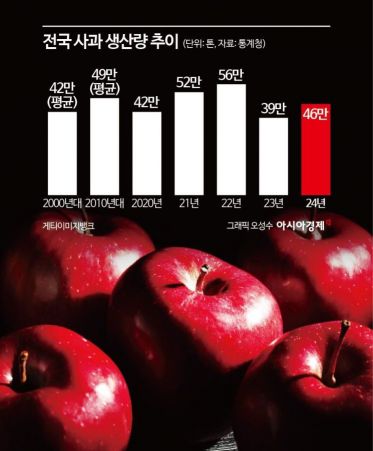
The fluctuation in apple prices is closely related to domestic apple production volumes. Statistics Korea has been compiling annual fruit production data since 2000, and apple production steadily increased during the first 20 years. However, production sharply dropped to 420,000 tons in 2020 due to the COVID-19 pandemic, seemed to recover to average levels the following year, but has declined again over the past two years. If this trend continues, domestic apple production is expected to revert to levels seen in the 2000s.
Climate change on the Korean Peninsula is identified as a factor behind poor apple yields. Apples are crops suited to cool climates; typically, spring apples bloom in mid-April when temperatures are around 15-16 degrees Celsius and bear fruit in June for harvest. However, recent spring weather patterns have been completely different from the past. For example, in 2023, a poor apple harvest year, temperatures suddenly warmed in March causing apple blossoms to bloom much earlier. But within days, a cold snap dropped temperatures to minus 2 degrees Celsius, freezing the apple blossoms.
If the problem with spring apple harvests lies in unpredictable spring temperatures, the challenge for summer apples is the monsoon season. In 2020, due to an unusually long monsoon period, apple fruits were affected by anthracnose and brown spot diseases, resulting in much of the fruit being discarded.
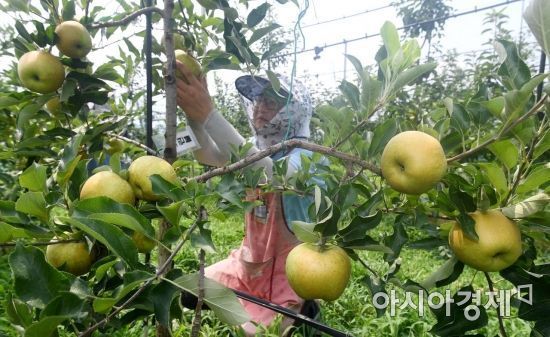 Apples grown in the orchard at the Gyeonggi-do Agricultural Research and Extension Services in Hwaseong-si, Gyeonggi-do. Not related to specific expressions in the article. Asia Economy DB
This issue was already mentioned in the 2022 report "Fruit Supply and Demand Outlook and Trends" published by the Korea Rural Economic Institute. At that time, the institute cited "spring cold damage and prolonged monsoon effects" as causes of poor fruit yields.
Additionally, the warming climate on the Korean Peninsula is gradually reducing the areas suitable for apple cultivation. According to the institute, decades ago apples were mainly grown in the Gyeongbuk region, but now the cultivation area proportions in Gangwon and Gyeonggi are increasing. However, overall cultivable area is likely to continue decreasing. The institute projected, "Apple cultivation area was 34,300 hectares in 2022 but will shrink to 29,100 hectares by 2031," estimating an annual decrease of 1.8%.
As apple production declines, Korean dietary habits may inevitably have to change. The institute forecasted, "Due to reduced domestic production, per capita apple consumption in Korea is expected to decrease from 10 kg in 2022 to 9.2 kg in 2031."
The government is responding to the apple production crisis by expanding smart orchard specialized complexes. Smart orchards use real-time monitoring and digital technologies to regulate sunlight exposure and prevent pests and diseases in fruit trees. Last year, the government established a 20-hectare smart orchard specialized complex in the Gangwon region and plans to create five new sites this year.
However, it is realistically difficult for all farms nationwide to bear the high investment costs of smart facilities. Ultimately, there is a growing need to develop new farming methods that respond to climate change while minimizing environmental impact.
Jeon Ji-hye, director of the Climate Change Response Agriculture Research Institute at the National Institute of Horticultural and Herbal Science under the Rural Development Administration, stated in last month’s report "Changes in Domestic Fruit Industry Due to Climate Change and Mid- to Long-Term Tasks," "With ongoing warming, the Korean Peninsula’s temperature is rising by 0.2 degrees Celsius every decade," and "spring average temperatures are increasing, causing earlier blooming of spring flowers."
She added, "Current predictions of cultivation area changes indicate that suitable apple cultivation areas will almost disappear nationwide," emphasizing, "Urgent development and distribution of new fruit tree varieties adapted to climate change are needed." Director Jeon also noted, "Eight crops including apples have already had 48 varieties developed and distributed," and recommended, "Standards for cultivation to reduce carbon emissions during agricultural production should also be established."
© The Asia Business Daily(www.asiae.co.kr). All rights reserved.














