Passed on to Consumers... Impact on Sales Volume
U.S. President Donald Trump has decided to proceed with imposing a 25% tariff on Mexico and Canada starting from the 4th (local time), raising concerns that U.S. car prices could increase by up to $12,000 (approximately 17.52 million KRW), Bloomberg reported on the 3rd.
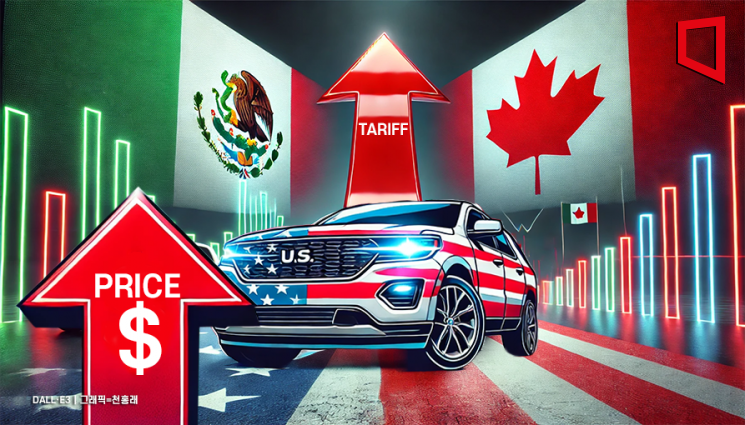
According to automotive consultant Anderson Economic Group, the cost of producing crossover utility vehicles (CUVs) is expected to increase by more than $4,000 due to the tariffs, with electric vehicles seeing a threefold increase. Additionally, prices for large sport utility vehicles (SUVs), which include a significant amount of Mexican-made parts, are expected to rise by about $9,000, and pickups by $8,000. These costs are likely to be passed on to consumers.
Patrick Anderson, CEO of Anderson Economic Group, stated, "This kind of cost increase will directly and almost immediately lead to a decline in sales of the most affected models," adding, "The scale of tariffs threatened by President Trump will have a sharply negative impact on car sales."
The policy of imposing a 25% tariff on Mexico and Canada could further worsen the automotive purchasing power crisis. Even before the tariffs, the average car price was approaching $50,000, which is more than a 20% increase compared to five years ago.
The New York Times (NYT) predicted that Nissan and Stellantis, which are already facing financial difficulties, could be the hardest hit by the tariffs. Nissan sold nearly one million cars in the U.S. market last year, with one-third assembled at its Mexican plants. Makoto Uchida, CEO of Nissan Motor, said during last month's earnings conference call, "If the (tariff) effects materialize, it will have a significant impact on profits."
In the case of Stellantis, about one-third of the profitable Ram pickups are assembled at the Saltillo plant in Mexico. Additionally, two Jeep models are produced at the Toluca plant in Mexico. NYT suggested that Stellantis might increase Ram production at U.S. plants while reducing output at the Saltillo plant.
Bloomberg forecasted that the tariffs would also affect popular models such as the Chevrolet Silverado pickup truck and the Ford Bronco Sport SUV. According to NYT, more than a quarter of the parts used in most Ford models rely on Mexican plants and suppliers. Volkswagen sold 230,000 Mexican-made cars in the U.S. market last year, accounting for about 60% of its U.S. sales.
Sources reported that executives from General Motors (GM), Ford Motor Company, and Stellantis recently warned the U.S. Department of Commerce about the severe economic consequences of the tariffs during meetings. Ford and Stellantis executives emphasized that the White House should instead focus on millions of imported vehicles that contain no American-made parts at all. However, Bloomberg reported that as the Trump administration pushes forward with the tariffs, there are even discussions about the potential discontinuation of some vehicle models.
There are already signs that car sales are declining due to high prices and high interest rates. Dan Hirschi, head of North American automotive practice at consulting firm AlixPartners, said that automakers might stop producing certain models in Canada and Mexico and move production to U.S. plants, potentially resulting in a decrease of 500,000 U.S. car sales.
Jim Farley, CEO of Ford, warned last month that imposing a 25% tariff on Mexico and Canada would "create a hole in the American industry."
© The Asia Business Daily(www.asiae.co.kr). All rights reserved.













