Ranked 6th in 2023 with $36,194...
Surpassing Japan, but
Structural factors such as export dependence, sluggish domestic demand, and high exchange rates must be considered
On the 5th, ahead of the Bank of Korea's announcement of 'per capita national income,' attention is focused on its scale and content. There is high expectation that the $40,000 benchmark, a standard for evaluating advanced countries, will be surpassed within a few years, but analysis suggests that structural reforms must accompany this for healthy growth and a real enhancement of the public's economic experience.
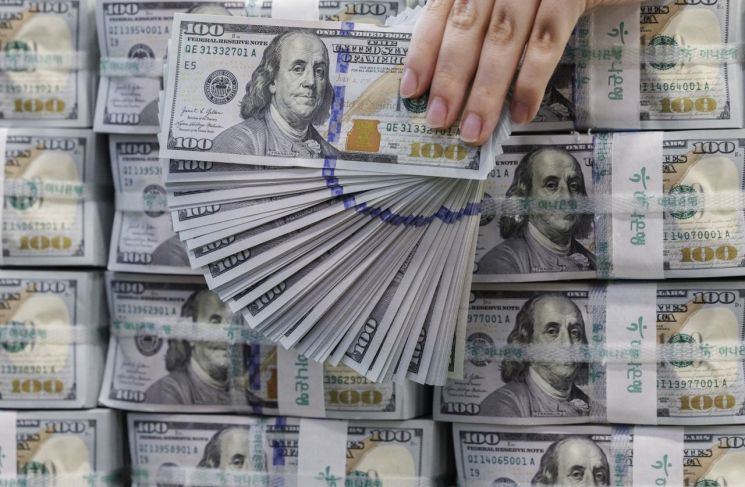
Ranked 6th in the world as of 2023... Interpretation of 'a decade in the $30,000 range'
On the 5th, the Bank of Korea will release the provisional figure for South Korea's per capita Gross National Income (GNI) for last year through the '2024 Q4 and annual national income (provisional)' announcement. GNI refers to the total income earned by all citizens over a certain period, including wages, interest, and dividends earned domestically and abroad. Therefore, it is used as an indicator of national purchasing power and living standards. Per capita GNI is calculated by adding citizens' overseas income to the Gross Domestic Product (GDP) and subtracting foreigners' domestic income, then dividing by the population.
South Korea's per capita GNI rose to $37,898 in 2021, then dropped to around $35,000 ($35,229) in 2022, and recovered to $36,000 ($36,194) in 2023. Being in the mid-to-high $30,000 range means that the purchasing power of South Korean citizens is at a high level. South Korea's per capita GNI increased 540 times from $67 in 1953 to $36,194 in 2023, with an average annual growth rate of 9.4%. As of 2023, South Korea's per capita GNI ranked 6th among countries with populations over 50 million, following the United States, Germany, the United Kingdom, France, and Italy. It also surpassed Japan for the first time in history.
However, the first time South Korea entered the $30,000 range was in 2014 ($30,798). Since then, it has remained in the $30,000 range for 10 years. Last year, with a growth rate recorded at only 2.0%, it is uncertain how much the per capita GNI will grow. Exports continued to perform well, reaching a record high of $683.8 billion last year, but sluggish domestic demand held back growth. The Bank of Korea will also release provisional figures for per capita GDP and economic growth rate on the 5th, revising the preliminary figures released in January by adding year-end industrial activity and other indicators.
Per capita GNI can fluctuate due to various factors such as exchange rates. A representative example of exchange rate impact is Japan. Japan experienced a decline in its currency value due to a record-weak yen, resulting in a decrease in its per capita GNI when converted to dollars. South Korea also recorded a high average annual won-dollar exchange rate of 1,363.98 won last year, up 58.57 won from the previous year, which likely had a negative effect on the increase in per capita GNI.
Per capita GNI also differs from the actual income felt by citizens. This is because GNI includes income earned not only by households but also by businesses and the government. According to the Ministry of Employment and Labor's January 2025 Business Labor Survey, the average nominal monthly wage last year increased by 2.9% from the previous year (3,966,000 won) to 4,079,000 won. Considering inflation, the real average monthly wage was 3,573,000 won, which was only a 0.5% increase from the previous year (3,554,000 won).
Population structure also affects this. Even if income remains the same, a declining population can cause per capita GNI to increase. While population decline negatively impacts economic growth, caution is advised against interpreting this as a genuine increase in GNI.
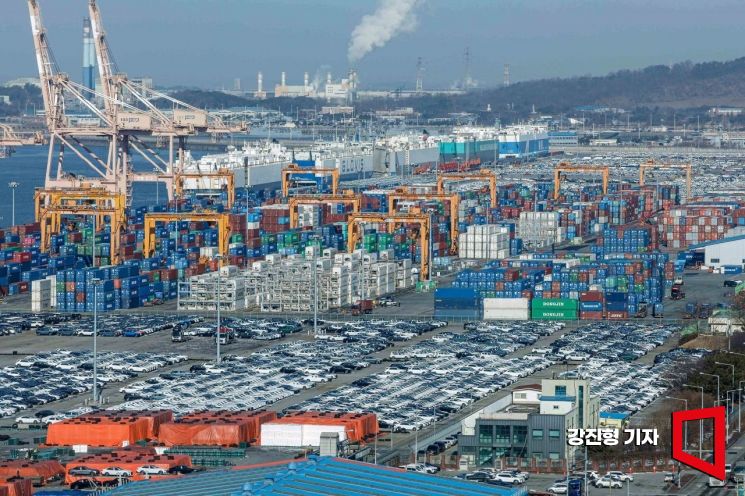 Following President Donald Trump's signing of a proclamation imposing a 25% tariff without exceptions on steel and aluminum products imported into the United States, and his announcement that tariffs on automobiles and semiconductors are also under consideration, export vehicles are waiting to be loaded at Pyeongtaek Port in Gyeonggi Province on the 13th of last month.
To give meaning to the $40,000 goal... continuous operation of growth engines through structural reforms is necessary
The main question is when the era of $40,000 per capita GNI, a symbol of advanced countries, will begin. Around the 2023 GNI announcement, the government and the Bank of Korea assessed that "if the current trend continues, reaching $40,000 is possible within a few years." However, experts believe that the content behind the $40,000 figure is more important than the number itself.
There are limitations to the export-driven economic growth structure, and this is currently facing challenges due to worsening trade conditions. The Bank of Korea lowered South Korea's economic growth forecast for this year to 1.5% in its revised outlook last month for this reason. This figure is below South Korea's continuously declining potential growth rate. South Korea's average potential growth rate for 2025-2030 is 1.8%. With the economy relying heavily on export industries such as semiconductors and automobiles, recent tariff pressures from former U.S. President Donald Trump have added to growth burdens. The Bank of Korea expects this year's current account surplus to be around $75 billion, less than last year's $99 billion.
Voices call for accompanying structural reforms to strengthen medium- to long-term growth engines. Experts emphasize the need to support growth in innovative industries to reduce export concentration, and also stress labor market reforms to address low birth rates and aging. The domestic economy must warm up with economic recovery so that citizens can truly feel the benefits. Otherwise, even if the $40,000 target is achieved, its practical significance will be limited. Professor Kang Sung-jin of Korea University’s Department of Economics said, "There are limits to the government stimulating the economy by spending money. In the medium to long term, the private sector must thrive, and for that, a foundation to support new industrial growth must be established."
© The Asia Business Daily(www.asiae.co.kr). All rights reserved.












