Sales of Nutritional Supplements Begin on the 24th
Daewoong Pharmaceutical and Ilyang Pharmaceutical Supply Products
High Interest in Stores Due to Cost-Effectiveness at 3,000 to 5,000 Won
Strong Opposition from Some Pharmacies and Pharmacist Groups
Some Manufacturers Decide to Withdraw After Just Five Days
Recently, at a Daiso store in the metropolitan area, health functional foods in small boxes of various colorful shades were lined up in a row among displays of daily necessities, stationery, and snacks. Visitors shopping here, ranging from people in their 20s and 30s to middle-aged and older adults, showed continuous interest as they passed by the displayed products.
There were dozens of products, from various vitamins to basic supplements labeled with calcium and magnesium, milk thistle, omega-3, lutein, propolis, and health functional foods claimed to be effective for joint and cartilage function improvement. A female visitor in her 50s carefully examined boxes labeled with calcium, magnesium, and vitamin D before filling both hands with 5 to 6 products. A couple in their 30s looked at children's vitamins and read the descriptions carefully, saying, "It's easy to take and tastes good."
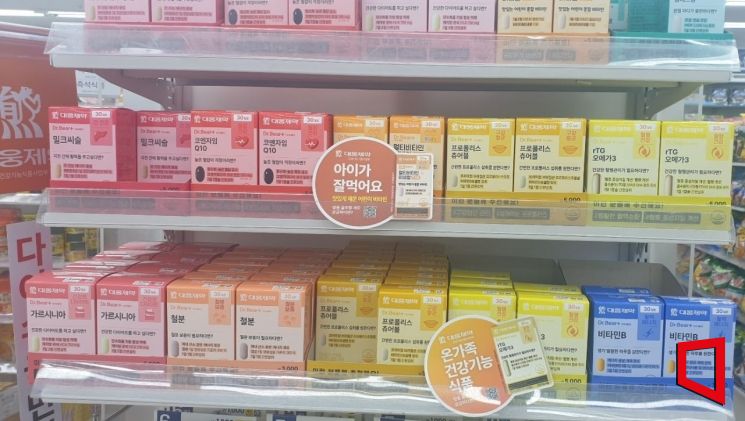 Health functional foods are displayed at a Daiso store in the Seoul metropolitan area. Photo by Kim Heung-soon
Since the 24th of last month, Daiso has started selling about 30 types of health functional foods made by Daewoong Pharmaceutical and Ilyang Pharmaceutical at 200 stores nationwide. In line with its uniform pricing policy, the products are priced at two levels: 3,000 won and 5,000 won. News that nutritional supplements and other products can be purchased at relatively low prices through Daiso has attracted significant attention in the market.
In fact, "nutritional supplements" consistently rank at the top of popular search terms on Daiso's online mall (Daiso Mall), which is operated independently. A female customer in her 60s said with a smile, "I can't be sure about the efficacy, but since these products are made by large pharmaceutical companies, there shouldn't be any problems. The prices are low, so I plan to try them out and share them with people around me."
However, some pharmacies and pharmacists have strongly opposed Daiso's sale of health functional foods. This is because, based solely on Daiso's pricing policy, existing pharmacies have been accused of excessively overcharging for nutritional supplements and other health functional foods. The Korean Pharmaceutical Association stated, "Health functional foods sold at pharmacies involve professional consultation by pharmacists and consideration of consumers' health conditions, so they cannot be simply compared by sales price alone." They urged a prompt correction regarding marketing that suggests pharmaceutical companies supplying products to Daiso are offering them at prices cheaper than pharmacies. Some online communities have even expressed intentions to boycott pharmaceutical companies supplying health functional foods to Daiso.
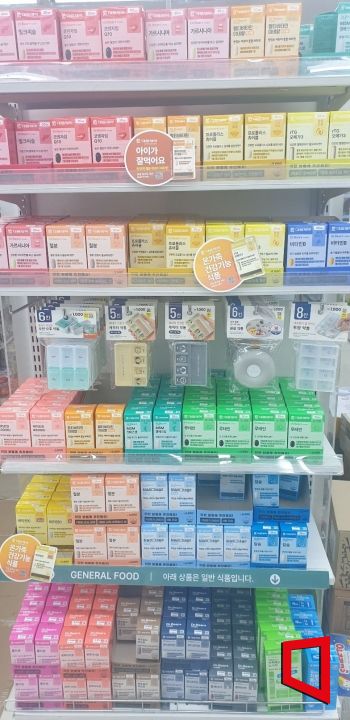 Health functional foods are displayed at a Daiso store in the Seoul metropolitan area. Photo by Kim Heung-soon
As a result, Ilyang Pharmaceutical decided to withdraw from Daiso after just five days. A Daiso representative said, "We received official notification from Ilyang Pharmaceutical," adding, "We will not stock any more products beyond the initial supply."
Another supplier, Daewoong Pharmaceutical, and Chong Kun Dang Health, which plans to launch health functional foods for Daiso as early as this month, are also considering whether to withdraw.
As the focus has been on the fact that health functional foods sold at Daiso are priced up to one-fifth of those sold at pharmacies, heated debates have erupted on online communities. Typical claims include that the ingredient content is insufficient or that the efficacy is inferior. Some argue that when the packaging size is reduced and the price per unit is calculated, the products are actually more expensive than those sold at pharmacies and other traditional outlets.
Daiso argues that since these products are sold under the manufacturers' names, there is no possibility of falsifying ingredients or content. Instead, unlike existing channels that usually sell supplements in 3 to 6-month supplies, Daiso reduces the quantity to a 30-day supply and compresses only the essential ingredients per product line to lower costs. A Daiso representative said, "We negotiate to supply as many units as possible according to the manufacturers' requests," adding, "By simplifying the distribution structure and excluding marketing costs, we maintain a uniform pricing policy through a low-margin, high-volume strategy."
© The Asia Business Daily(www.asiae.co.kr). All rights reserved.













