Korea University announced on the 1st that a research team led by Professor Park Seongcheol from the Department of Health Policy and Management proved that the increase in per capita medical expenditure in Korea coincides with a decrease in disease burden.
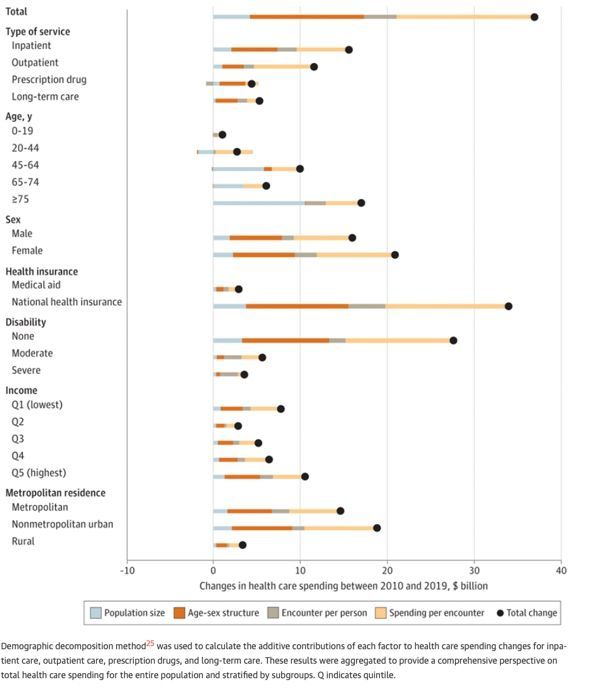 Results of calculating the additional contribution of each factor to changes in medical expenses for inpatient treatment, outpatient treatment, prescription drugs, and long-term care. Demographic decomposition method 25 used. Provided by Korea University.
The paper was published last month in the international journal 'JAMA Health Forum'. According to the study, Korea's medical expenditure increased from 55 billion dollars in 2010 to 92 billion dollars in 2019. This represents an increase of more than 60% over 10 years. The main cause of the increase in medical expenses was found to be the rise in per capita medical expenditure.
Per capita disease burden was found to have decreased by 233%. The research team revealed that the overall disease burden in Korean society increased by about 7%, which was attributed to aging and population growth. To investigate health improvements, they analyzed disability-adjusted life years (DALYs). Disability-adjusted life years (DALYs) represent the number of years of healthy life lost due to premature death or disability.
Professor Park said, "Currently, medical services in our country are being used efficiently, but specific policy reviews are needed to prepare for rapid aging."
© The Asia Business Daily(www.asiae.co.kr). All rights reserved.












