Evaluation by Economist Intelligence Unit
7.75 out of 10... Lowest Score Since 2006
"Political Deadlock Continues After Martial Law Declaration"
As a result of the December 3 emergency martial law, South Korea's democracy index fell out of the top-tier category last year. On the 28th, Yonhap News cited the 'Democracy Index 2024' by the Economist Intelligence Unit (EIU), an economic analysis institute affiliated with the British weekly magazine The Economist, reporting that "South Korea ranked 32nd out of 167 countries worldwide in democracy maturity last year, dropping 10 places from the previous year."
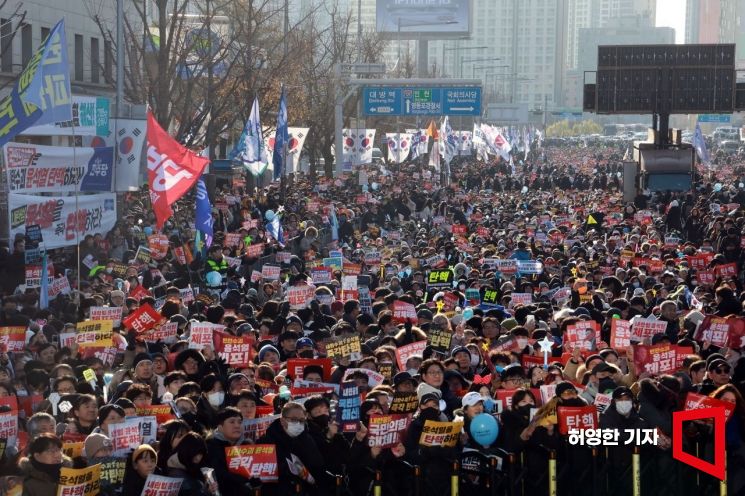 Participants are shouting slogans at a rally calling for impeachment held in front of the National Assembly in Yeouido, Seoul, on December 14 last year, when the second impeachment vote against President Yoon Seok-yeol was scheduled. Photo by Heo Young-han
South Korea scored 7.75 out of 10 points (32nd place), significantly down from 8.09 points (22nd place) in 2023. As a result, it fell from the 'full democracy' category, which it had been included in for four consecutive years since 2020, to the 'flawed democracy' category.
According to Yonhap News, since 2006, the EIU has evaluated 167 countries across five areas to calculate democracy development scores. Countries scoring above 8 points are classified as 'full democracies,' those scoring above 6 up to 8 points as 'flawed democracies,' those scoring above 4 up to 6 points as 'hybrid regimes,' and those below 4 points as 'authoritarian regimes.' The total score of 7.75 is the lowest South Korea has received since the index began in 2006, and the 0.34-point drop is the ninth largest decline among the 167 countries.
The scores by category were △ electoral process and pluralism 9.58 points △ functioning of government 7.50 points △ political participation 7.22 points △ political culture 5.63 points △ civil liberties 8.82 points. Among these, the scores for functioning of government (8.57 → 7.50) and political culture (6.25 → 5.63) declined compared to the previous year, while the other categories remained the same.
In its report, the EIU stated, "South Korea's scores for functioning of government and political culture were downgraded due to the declaration of emergency martial law and the subsequent political deadlock." It added, "The aftermath of President Yoon Seok-yeol's attempt to declare martial law heightened polarization and tension in the parliament and among the public, which is likely to continue into 2025. Public dissatisfaction with South Korea's democracy may increase."
The global average score was 5.17 points, marking the lowest since 2006. The highest score was 5.55 points in 2015. Only 6.6% of the world's population lives in the 25 countries classified as 'full democracies,' a significant decrease from 12.5% ten years ago, and it is estimated that two out of every five people worldwide live under authoritarian regimes. Norway ranked first for the 16th consecutive year with a total score of 9.81 points, followed by New Zealand (9.61 points), Sweden (9.39 points), and Iceland (9.38 points). North Korea ranked 165th, third from the bottom, with a score of 1.08 points. Only Myanmar (0.96 points) and Afghanistan (0.25 points) scored lower than North Korea.
The United States maintained its position as a 'flawed democracy,' rising one place to 28th (7.85 points) from the previous year. The EIU pointed out, "(The U.S.) may face bigger challenges this year," noting, "President Donald Trump challenged the political independence of civil servants in the first month of his second term and issued a series of executive orders with questionable legal authority." It further stated, "Trump's election was part of a global backlash against established regimes," and predicted, "The next test for global democracy in 2025 will be how newly elected leaders govern."
© The Asia Business Daily(www.asiae.co.kr). All rights reserved.












