Jeonnam Province Ranks First in Total Fertility Rate Nationwide for Two Consecutive Years in 2024
Number of Births Increases by 398 from Previous Year, First Rebound in Nine Years
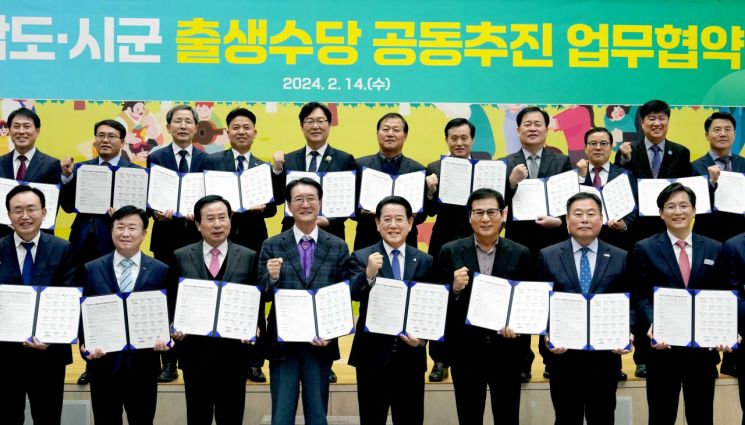 The total fertility rate in Jeonnam region in 2024 recorded 1.03, surpassing 1.0 along with Sejong City, ranking first nationwide for two consecutive years. Kim Youngrok, governor of Jeollanam-do, is seen signing a business agreement with the mayors and county heads of 22 cities and counties at the provincial office on February 14, 2024, to successfully promote the birth allowance program in Jeonnam. Provided by Jeonnam Province
Jeonnam Province recorded a total fertility rate of 1.03 in the region last year, ranking first in the nation for two consecutive years. The number of births also rebounded for the first time in nine years, increasing by 398 compared to the previous year.
According to the "2024 Birth and Death Statistics (Provisional)" released by Statistics Korea on the 26th, the number of births in Jeonnam in 2024 was 8,226, an increase of 398 (5.1%) from the previous year (7,828), marking the first rebound in the number of births in nine years.
In particular, Jeonnam's total fertility rate increased by 0.06 from the previous year's 0.97 to 1.03, with as many as five counties?Yeonggwang, Gangjin, Jangseong, Hampyeong, and Goheung?ranked among the top ten cities and counties nationwide for total fertility rate. In addition, ten cities and counties, including Naju, Gwangyang, Boseong, and Hwasun, surpassed a total fertility rate of 1.0.
The total fertility rate is the average number of children a woman is expected to have during her childbearing years (ages 15?49), and is a key indicator of a country or region's birth rate.
Jeonnam Province analyzed that its proactive birth policies, such as providing integrated services from pregnancy to childbirth, are beginning to yield results in creating a favorable environment for having and raising children.
Kim Myungshin, Director of the Population and Youth Policy Bureau of Jeonnam Province, said, "To increase the birth rate and provide practical support to families raising children, we are investing 61.5 billion won in 39 projects for this year's birth policy. By offering integrated, customized services for pregnancy, childbirth, and childrearing, we will continue the upward trend in birth rates and achieve a total fertility rate of 1.5 by 2030."
© The Asia Business Daily(www.asiae.co.kr). All rights reserved.











