KDCA Designates Seven Countries Including Uganda and South Sudan as "Quarantine Management Areas"
"Refrain from Contact with Wild Animals and Visiting Funeral Homes When Traveling"
As Ebola virus disease patients continue to emerge in Uganda, Africa, health authorities have decided to strengthen quarantine measures for travelers entering from Uganda and six other African countries.
The Korea Disease Control and Prevention Agency (KDCA) announced that starting from the 26th, Uganda, South Sudan, Rwanda, Kenya, the Democratic Republic of the Congo, Tanzania, and Ethiopia will be designated as Ebola virus disease quarantine management areas. Quarantine management areas are regions where quarantine infectious diseases are either epidemic or likely to become epidemic, posing a risk of introduction into the country. The designation is made by the KDCA commissioner after review by a specialized committee in accordance with the Quarantine Act.
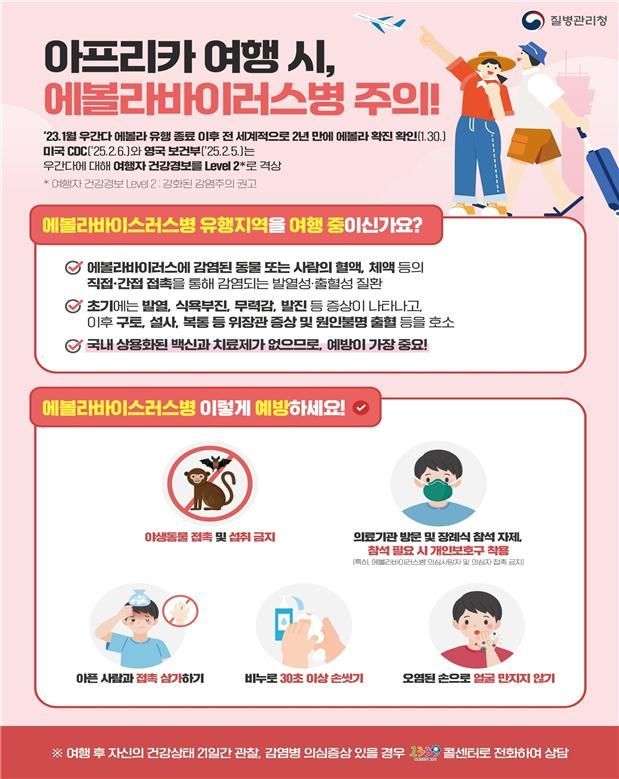
Ebola virus disease is an acute febrile and hemorrhagic illness caused by infection with the Ebola virus. It spreads through contact with infected animals or through contact with the blood or bodily fluids of infected patients or deceased individuals. The disease has a high fatality rate, and there are currently no commercially available vaccines or treatments.
According to the KDCA, Ebola virus disease has sporadically occurred in some African countries. In Uganda, a nurse in her 30s who was infected died on the 30th of last month, marking the first death in two years. Eight additional confirmed cases recovered after hospitalization and were all discharged by the 18th, and as of the 20th, 58 people remain under management in isolation facilities.
Among travelers entering from the countries designated as quarantine management areas, those exhibiting suspicious symptoms such as fever, loss of appetite, fatigue, or rash must report their health status to quarantine officers via the Q-code or health status questionnaire.
Health authorities will deploy epidemiologists and public health doctors at the gate for direct flights from Ethiopia at Incheon Airport to monitor for fever and enable symptomatic individuals to report themselves, thereby strengthening quarantine. Additionally, medical institutions will be provided with Ebola virus disease guidance for healthcare workers. If travelers from quarantine management areas develop symptoms after returning and visit medical institutions, their overseas travel history will be provided to the institutions through the Drug Utilization Review (DUR) and International Travel History System (ITS) to assist in diagnosis and prescription.
Ji Young-mi, commissioner of the KDCA, stated, "Ebola virus disease is transmitted through contact with patients rather than respiratory transmission, so it does not spread rapidly. However, we are working to minimize the possibility of domestic occurrence." She urged, "Citizens traveling to epidemic countries should avoid contact with fruit bats, primates, and wild animals during travel, refrain from visiting funeral homes locally, and wear personal protective equipment such as masks when visiting medical institutions, strictly adhering to preventive measures."
© The Asia Business Daily(www.asiae.co.kr). All rights reserved.












