The partial amendment bill to the "Act on the Establishment and Operation of the Korea Communications Commission" (KCC Establishment Act), which specifies the quorum for resolutions of the Korea Communications Commission (KCC) as three or more members, passed the National Assembly's Legislation and Judiciary Committee on the 26th.
The National Assembly's Legislation and Judiciary Committee held a plenary meeting that morning and passed the amendment to the KCC Establishment Act led by the opposition party. Among the total 16 members from both ruling and opposition parties, all six ruling party members opposed it, but the 10 opposition party members voted in favor, resulting in its approval.
The amendment sets the minimum quorum for KCC meetings at three members and requires a majority of attending members for resolutions. This is to prevent decisions from being made solely by the two members appointed by the president, the chairman and vice-chairman. Additionally, it mandates that members recommended by the National Assembly and replacement members be appointed within 30 days from the date of recommendation by the National Assembly, and that meetings of the Broadcasting and Communications Deliberation Committee be broadcast live to the public.
The KCC currently operates with a total of five members, including the chairman and vice-chairman appointed by the president, and the remaining three members recommended by the National Assembly.
Lee Jin-sook, Chairperson of the KCC, described the amendment as "effectively a law that paralyzes the Korea Communications Commission," stating, "I have personally experienced that it was created so that at least two members can make decisions on matters related to public welfare." She cited the recent decision to exempt households affected by heavy rain from subscription fees as an example. She added, "It is desirable that the KCC Establishment Act be enacted after sufficient bipartisan consultation and agreement," and requested once again, "I ask the National Assembly to recommend three standing committee members."
Meanwhile, the partial amendment bill to the "Telecommunications Business Act," which requires the Ministry of Science and ICT and the KCC to inspect compliance with registration requirements of bulk message transmission operators once a year on a regular basis and to establish a legal basis for the transmission qualification certification system, also passed on the same day. The bulk message transmission qualification certification system refers to a system where message resellers providing large-scale text message transmission services via the internet network must obtain transmission qualification certification from mobile carriers or message relay operators in order to send bulk messages.
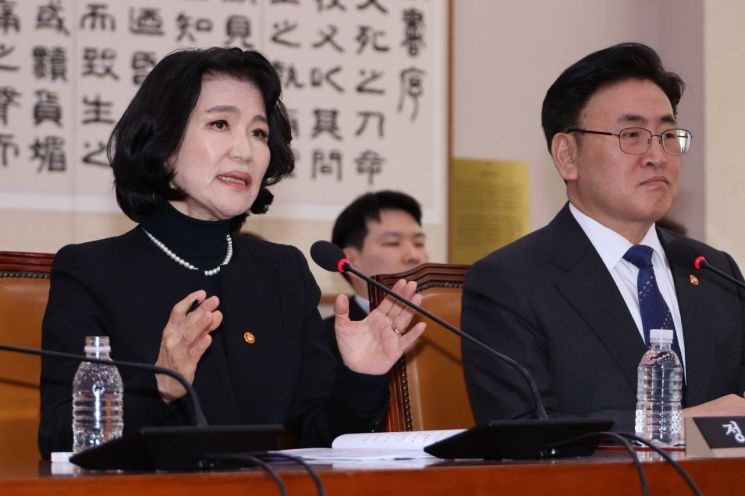 Lee Jin-sook, Chairperson of the Korea Communications Commission, is responding to questions from committee members at the plenary session of the National Assembly's Legislation and Judiciary Committee on the 26th. Photo by Yonhap News
© The Asia Business Daily(www.asiae.co.kr). All rights reserved.











