A technology that implements ultra-precise color graphics without using chemical pigments has been developed domestically. This technology is eco-friendly as it does not use chemical pigments, and it has the advantage of permanently preserving color graphics without discoloration or fading.
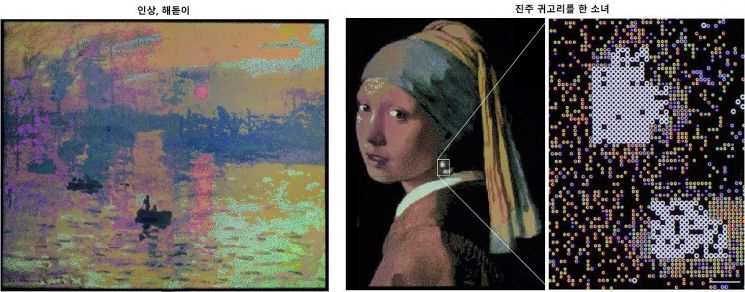 Masterpieces reproduced without pigments: 'Impression, Sunrise (left)', 'Girl with a Pearl Earring (right)'. Provided by KAIST
On the 26th, KAIST announced that Professor Kim Shinhyun's research team from the Department of Bio and Chemical Engineering developed a technology that realizes high-resolution color graphics without any chemical pigments using hemispherical microstructures.
Previously, morpho butterflies with blue hues and panther chameleons that change skin color were able to display colors without chemical pigments. This is due to the structural color that appears as a result of regular nanostructures in the material reflecting visible light through light interference phenomena.
Structural color varies according to the structure rather than the material, so various colors can be expressed with a single material.
However, the technical difficulty of artificially implementing regular nanostructures for structural color expression is high, and it is difficult to represent various colors, as well as to express colors in intricate pattern forms.
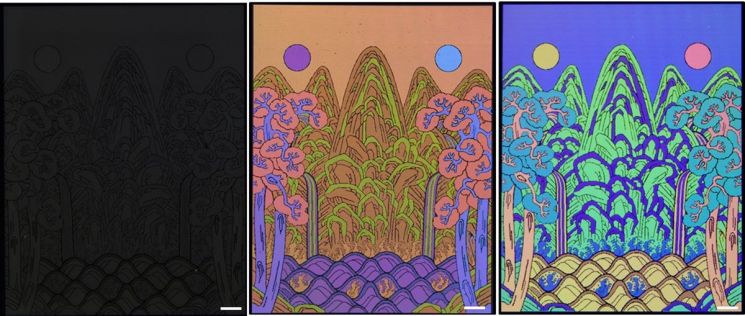 'Ilwol Obongdo' appears differently depending on the angle of light and the viewing direction. Photo by KAIST
Accordingly, the research team developed a technology that can pattern various structural colors with high precision using hemispherical microstructures with smooth surfaces instead of regular nanostructures.
When light is incident on the inverted hemispherical microstructure, light incident from the side undergoes total internal reflection along the curved surface, causing recursive reflection. When the diameter of the hemisphere is 10 μm (about one-tenth the thickness of a hair), light traveling along different paths that undergo recursive reflection interferes in the visible light range, producing structural color.
At this time, the structural color can be adjusted according to the size of the hemisphere, and by arranging hemispheres of different sizes like mixing paints on a palette, the number of expressible colors can be infinitely increased.
To precisely pattern hemispherical microstructures of various sizes, the research team used a positive photoresist polymer (a photosensitive material that dissolves easily in areas exposed to ultraviolet light) used in semiconductor processes, patterned it into micro-pillar shapes through photolithography (a patterning method used in semiconductor processes), and then raised the temperature to induce the photoresist polymer shape to form a curved surface, thereby creating hemispherical microstructures.
Using this method, hemispherical microstructures with desired sizes and colors can be formed at desired locations in a single step according to a pre-designed method, and arbitrary color graphics can be reproduced using only a single material without pigments, according to the research team.
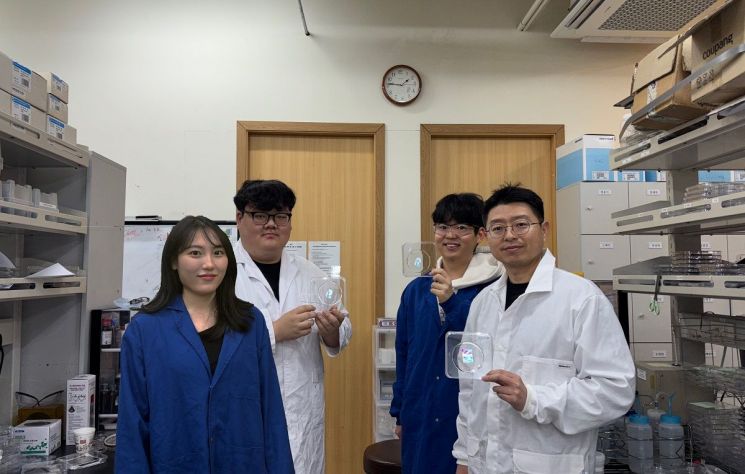 (From left) Son Chaerim (first author), master's graduate in Bio and Chemical Engineering, Dr. Nam Seongkyung, Ph.D. graduate, Lee Jiwoo, Ph.D. candidate, and Professor Kim Shinhyun. Provided by KAIST
The ultra-precise color graphic technology capable of permanent color preservation can change color depending on the angle of light incidence or viewing angle, and has the characteristic of a Janus-type structure that shows color on one side of the pattern and is transparent on the opposite side. Such structural color graphics have a high resolution comparable to the latest LED displays, enabling not only the representation of complex color graphics the size of a fingernail but also the display on large-area screens.
Professor Kim Shinhyun said, “We hope that the pigment-free color graphic implementation technology developed by our research team will be combined with the field of art in the future to become an innovative method for expressing new forms of artworks,” and added, “This technology can also be applied to a wide range of fields including optical devices and sensors, anti-counterfeiting materials, and aesthetic photo cards.”
Meanwhile, this research was conducted with support from the Future Convergence Pioneer Project and Mid-Career Researcher Support Project of the National Research Foundation of Korea.
© The Asia Business Daily(www.asiae.co.kr). All rights reserved.