KEPCO: "Settlement with KHNP after receiving additional costs from UAE"
KHNP: "Service fees must be settled first, separate from UAE settlement"
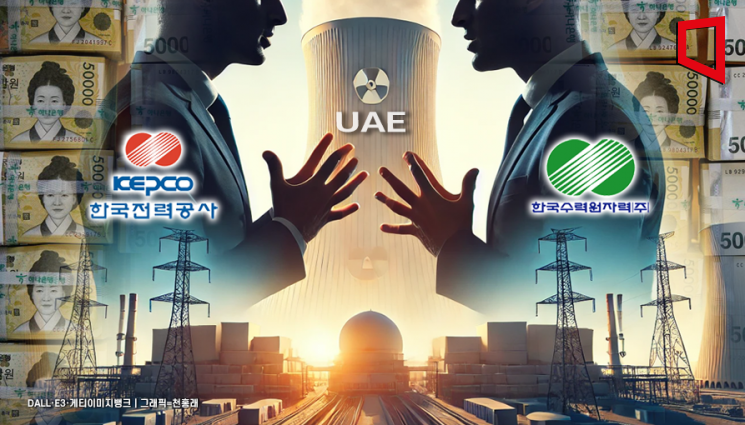
Conflict between Korea Electric Power Corporation (KEPCO) and Korea Hydro & Nuclear Power (KHNP) over the handling of approximately 1.4 trillion KRW in additional costs incurred during the construction of the Barakah Nuclear Power Plant in the United Arab Emirates (UAE), Korea's first nuclear power export, remains unresolved. KHNP is demanding settlement of the additional construction fees, but KEPCO insists that "receiving the additional costs from the UAE side first" must come before any settlement, raising the possibility of the dispute escalating into an international conflict.
According to the power industry on the 24th, KEPCO President Kim Dong-chul and KHNP President Hwang Ju-ho recently met privately to discuss the issue of handling the additional costs for the Barakah Nuclear Power Plant in the UAE, but failed to reach a resolution. Both presidents plan to continue discussions through their working-level teams.
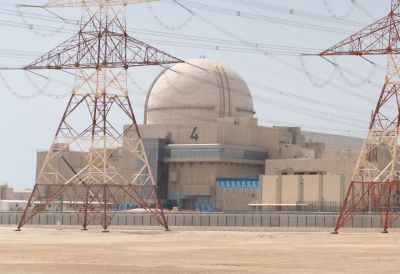
The total contract amount for the Barakah Nuclear Power Plant, consisting of four units, was approximately 20 trillion KRW. After the last unit, Unit 4, entered commercial operation last year, the project was completed, and final settlement work is underway among KEPCO as the main contractor, KHNP responsible for the Operation Support Service (OSS) during commissioning, and various other partners.
KEPCO's position is that, as part of "Team Korea," they should first recover the additional construction costs incurred from the UAE, and only then discuss how to distribute these costs within "Team Korea." On the other hand, KHNP argues that although it is a 100% subsidiary of KEPCO, it provided services based on the OSS contract signed as independent legal entities, and therefore, separate from KEPCO's settlement with the UAE as the client, KHNP should settle its service fees objectively according to its share.
According to KHNP, it has requested payment for additional OSS costs from KEPCO annually since June 2020, but payments have been delayed. Consequently, in November last year, KHNP formally filed a claim demanding settlement of additional costs amounting to 1 billion USD. A KHNP official stated, "Most of KHNP's claims are due to KEPCO's responsibility under the contract between KHNP and KEPCO. KEPCO has paid costs related to its responsibilities to partners regardless of the client. KHNP's current claim is a legitimate request following contractual procedures."
KEPCO countered that it requested KHNP to provide supporting documents necessary for negotiating the settlement amount, but KHNP has not submitted them. A KEPCO official said, "KEPCO is conducting local negotiations with the client and is sincerely carrying out negotiations with KHNP. We are even considering allowing KHNP to participate directly in negotiations with the client. If KHNP submits the necessary evidence for payment and its validity is verified, KEPCO plans to pay the corresponding costs."
KHNP maintains that it has already submitted the supporting documents. A KHNP official said, "KHNP has already submitted sufficient evidence over several years and can provide additional documents if requested. KEPCO's claim that it will negotiate with the client first to receive the costs and then pay is a tactic to delay additional cost negotiations with partners and simply distribute only part of the funds received from the client, shirking the main contractor's responsibility and shifting costs onto partners."
The OSS contract between KEPCO and KHNP stipulates that if disagreements between the two parties cannot be resolved at the claim stage, legal resolution will be sought through the London Court of International Arbitration (LCIA). Both KEPCO and KHNP have already appointed law firms in preparation for potential international disputes.
This conflict between the two companies arose over who will bear and how much of the unexpected additional construction costs of approximately 1.4 trillion KRW will be borne. For KHNP, if it cannot settle the additional costs with KEPCO, it will have to bear a loss of 1.4 trillion KRW. For its parent company KEPCO, if it fails to recover the additional costs from the UAE client, it will have to reflect an additional loss of approximately 1.4 trillion KRW in its financial statements.
© The Asia Business Daily(www.asiae.co.kr). All rights reserved.













