Resident Foreign Currency Deposits Rise by 2.14 Billion Dollars in January
Companies Accumulate Reserve Funds Amid Domestic and Global Uncertainties
Dollar Deposits Reach Largest Scale in Two Years
Yen Deposits Increase for the First Time in Four Months
Resident foreign currency deposits increased by more than 2.1 billion dollars in one month, mainly driven by dollar deposits. Despite the high exchange rate, the weight of domestic and international uncertainties led companies to secure reserve funds. As demand to stockpile dollars while they are relatively cheap increased, the balance of dollar deposits reached the largest scale since January 2023.
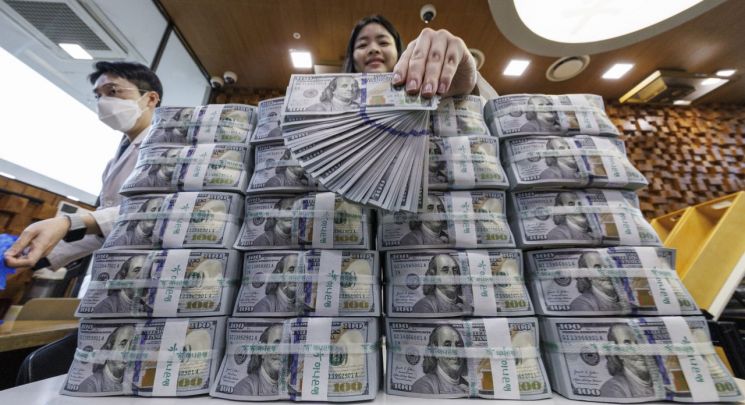 An employee at Hana Bank's Counterfeit and Alteration Response Center in Jung-gu, Seoul, is organizing US dollars. Photo by Yonhap News
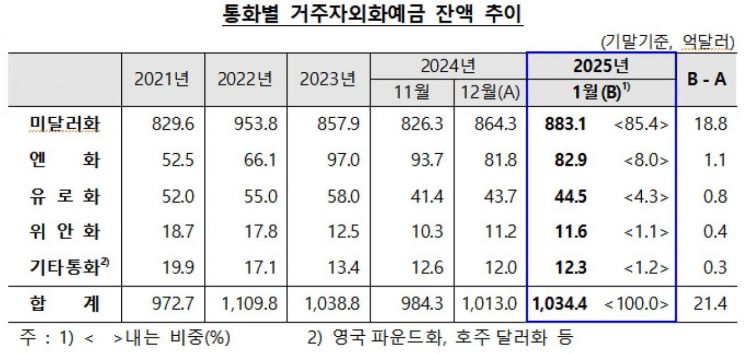
According to the resident foreign currency deposit trends announced by the Bank of Korea on the 24th, as of the end of January, resident foreign currency deposits at foreign exchange banks amounted to 103.44 billion dollars, an increase of 2.14 billion dollars compared to the end of the previous month. This marks two consecutive months of growth. Resident foreign currency deposits include foreign currency deposits held by nationals, domestic companies, foreigners residing in Korea for more than six months, and foreign companies operating domestically.
By currency, dollar deposits, which account for the largest share (85.3%) of resident foreign currency deposits, increased by 1.88 billion dollars compared to the end of the previous month. A Bank of Korea official stated, "The increase was due to export and import companies securing reserve funds amid expanding domestic and international uncertainties," adding, "Resident foreign currency deposits increased mainly in dollars and corporate deposits."

The won-dollar exchange rate fell by 19.8 won from 1,472.5 won at the end of December last year to 1,452.7 won at the end of last month. Although the high exchange rate trend in the mid-1,400 won range continues, companies anticipating a further rise in the won-dollar exchange rate due to increased domestic and international uncertainties such as tariff pressures from Trump bought more dollars. The balance of dollar deposits was 88.31 billion dollars, the highest since January 2023 (92.34 billion dollars).
Yen deposits increased by 110 million dollars compared to the previous month. The yen's appreciation led to an increase in the dollar equivalent of yen deposits, marking an increase for the first time in four months. The yen-dollar exchange rate decreased by 2.5 yen from 157 yen at the end of December last year to 154.4 yen at the end of January this year. In addition, euro and yuan deposits increased by 80 million dollars and 40 million dollars, respectively.
By depositor type, corporate deposits increased by 2.08 billion dollars to 89.2 billion dollars compared to the previous month, while individual deposits rose by 60 million dollars to 14.24 billion dollars. By bank type, domestic banks increased by 1.89 billion dollars to 88.61 billion dollars, and foreign bank branches increased by 250 million dollars to 14.83 billion dollars.
© The Asia Business Daily(www.asiae.co.kr). All rights reserved.














