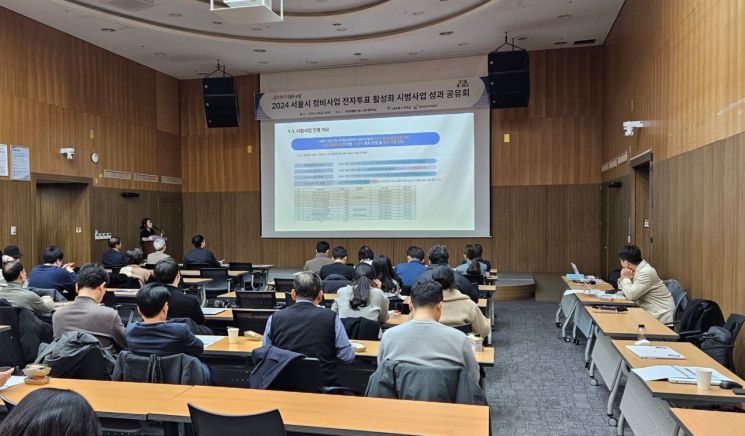
 A scene from the performance sharing meeting of the pilot electronic voting project for maintenance work held on the 14th at the large conference room of Seosomun Government Complex in Seoul. Provided by Seoul City
The introduction of electronic voting at general meetings for maintenance project associations resulted in a satisfaction rate of 98%.
On the 24th, Seoul City announced that a survey of 420 association members participating in the pilot project to promote electronic voting in maintenance projects showed a satisfaction rate of 98% or higher. Opinions stating that it was "more convenient compared to the existing method" were also recorded at 97.1%.
Previously, the city promoted the pilot project to activate electronic voting in maintenance projects by utilizing the Information and Communication Technology (ICT) regulatory sandbox system to proactively support redevelopment and reconstruction. Starting with the reconstruction association of Geonyeong Apartment in Miseong-dong, Gwanak-gu in October last year, electronic voting services were provided to a total of 10 associations up to the reconstruction association of Sindonga Apartment in Seocho-dong in January this year.
Electronic voting also proved effective in cost reduction. A survey of 22 association executive members regarding cost savings found that 61% reported "10-15% or more savings." The pre-voting period for general meetings, which usually took more than three weeks, was shortened by 3 to 12 days or more, reducing the required manpower and time. The time needed to count written resolution ballots during the general meeting also decreased.
Participation rates increased among young and middle-aged groups. However, for the elderly, measures to enhance participation such as tutorial videos and guidance from dedicated promotional staff were found to be necessary.
The average electronic voting participation rate among the 10 selected associations was 48.2%, with the reconstruction association of Sindonga Apartment in Seocho-dong recording a maximum electronic voting rate of 64.5%. By age group, the electronic voting rates relative to the total number of association members were 23.7% for those under 20 to their 40s, 34.6% for those in their 50s to 60s, and 6.2% for those in their 70s to 80s.
Going forward, with the government announcing amendments to the Enforcement Decree of the Urban Maintenance Act allowing resolutions at general meetings to be made electronically, electronic decision-making will be possible without using the regulatory sandbox system. This is expected to increase member participation in important decision-making.
Following a performance sharing meeting held on the 14th, the city plans to prepare an "Electronic Voting Implementation Work Guideline" to enable electronic handling of all aspects of association general meetings, including meeting preparation, opening, progress, and resolution.
Choi Jin-seok, Director of the Housing Office of Seoul City, stated, "Based on this electronic voting pilot project, we are actively implementing the 'Maintenance Project Electronic Voting and Online General Meeting Activation Project' this year. We plan to conduct additional public recruitment in March and April, and hope that more maintenance project associations will participate."
© The Asia Business Daily(www.asiae.co.kr). All rights reserved.












