‘Emergency Advisory Committee’ under National Assembly Speaker Holds Meeting in Gwangju
Discussions on Improving Systems for Introducing ‘Agrivoltaics’
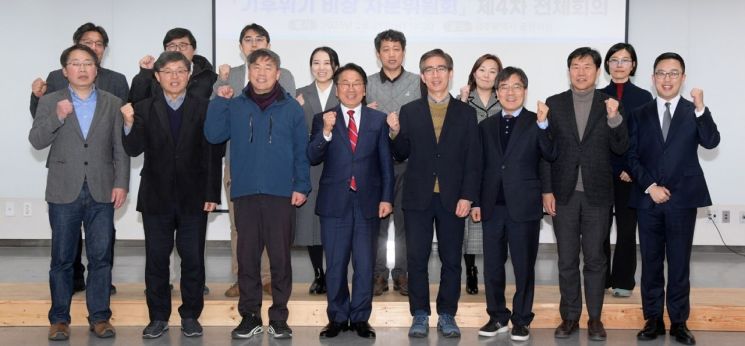 Kang Kijeong, mayor of Gwangju, attended the 4th meeting of the Climate Crisis Emergency Advisory Committee under the Speaker of the National Assembly held on the afternoon of the 21st in the city hall's medium conference room, and took a commemorative photo with the advisory committee members. Provided by Gwangju City
The National Assembly, the government, and Gwangju City have joined forces to respond to the escalating climate crisis and achieve carbon neutrality.
Gwangju City announced that the 4th meeting of the "Emergency Advisory Committee on Climate Crisis," under the direct supervision of National Assembly Speaker Woo Wonshik, was held on the 21st in the city hall’s main conference room.
The "National Assembly Emergency Advisory Committee on Climate Crisis" was established in August last year under the direct supervision of Speaker Woo Wonshik to provide policy and legislative support for responding to the climate crisis. The committee consists of 15 members, including Chairman Hong Jongho, an environmental economist; former lawmaker Kim Hyunkwon, who has worked on rural energy transition; and former Vice Minister of Environment Hong Jeonggi.
The meeting was attended by 12 advisory committee members including Chairman Hong Jongho, Gwangju Mayor Kang Gijung, Park Haecheong, Director of the Rural Carbon Neutral Policy Division at the Ministry of Agriculture, Food and Rural Affairs, representatives from Korea Rural Community Corporation, Korea Energy Agency, and external experts.
The meeting discussed directions for institutional improvements to introduce "agrivoltaics," as well as policy support measures to encourage farmer participation. In particular, as "agrivoltaics" is drawing attention as a model for coexistence between agriculture and renewable energy, opinions were presented on the need to establish a social dialogue body involving farmers, local governments, experts, and civil society, and to prepare an institutional foundation to coordinate this. There was also consensus that policy design must consider sustainable agriculture and secure acceptance among rural residents.
The advisory committee emphasized that institutional support, such as legal amendments related to inland agrivoltaics, is urgently needed at the government and National Assembly level.
Meanwhile, the meeting also introduced a renewable energy business model with direct resident participation. Ways for local residents to share economic benefits and contribute to regional development by participating in such projects were discussed.
Chairman Hong Jongho stated, "Expanding renewable energy to respond to the climate crisis is an urgent task of our time that can no longer be delayed," and added, "We will continue discussions to establish ways for agriculture and energy to coexist and to realize an energy transition centered on farmers."
Mayor Kang Gijung said, "To expand renewable energy in Gwangju, an inland city, it is necessary to expand agrivoltaics," and added, "Local governments will actively take the lead in expanding agrivoltaics through institutional support at the government level and support for social dialogue bodies at the National Assembly level."
© The Asia Business Daily(www.asiae.co.kr). All rights reserved.












