Emergency Meeting on Trump’s Second-Term Tariff Policy Held on the 21st
Governor Kim Shares Opinions on Mid- to Long-Term Countermeasures
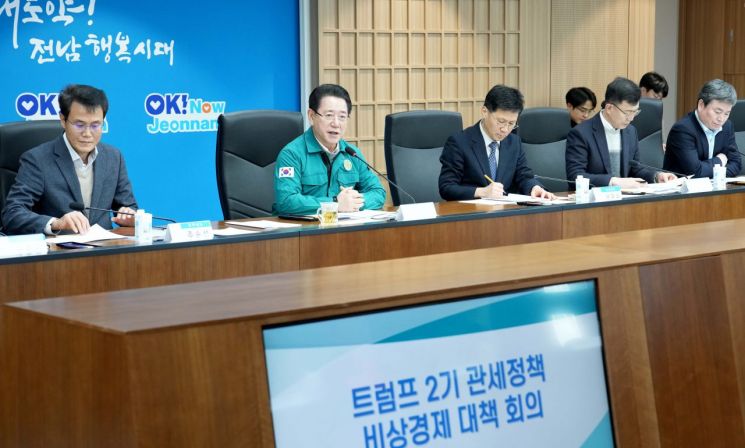 Jeollanam-do Governor Kim Youngrok is presiding over the "Trump Second Term Tariff Policy Emergency Economic Measures Meeting" at the Jeonnam Provincial Government East Office on the 21st, discussing the diagnosis of crises affecting the province, such as direct and indirect decreases in exports to the United States, and response plans. Provided by Jeonnam Province
On the 21st, Jeollanam-do held an 'Emergency Economic Measures Meeting on Trump’s Second-Term Tariff Policy' presided over by Governor Kim Yungrok to discuss ways to minimize tariff-related damages to local industries and enhance their competitiveness in response to the Trump administration's second-term tariff policies.
The meeting was attended by 20 members of the Task Force for Responding to Trump’s Second-Term Tariff Policy, which consists of economic-related organizations such as the local Chambers of Commerce, the Bank of Korea Gwangju-Jeonnam Headquarters, the Bank of Korea Mokpo Headquarters, the Korea Industrial Complex Corporation Jeonnam Regional Headquarters, KOTRA Gwangju-Jeonnam Support Office, the Korea International Trade Association Gwangju-Jeonnam Regional Headquarters, Jeonnam Research Institute, and Jeonnam Technopark.
Representatives and officials from companies expected to be directly or indirectly affected by the imposition of tariffs on steel and aluminum products, and thus facing reduced exports to the US?such as POSCO Gwangyang Steelworks, Hyundai Steel Suncheon Plant, Gwangyang Aluminum, Sammi Metal, Asia T&C, and Seah Steel Suncheon Plant?also participated to explore various countermeasures.
The Trump administration announced on the 10th (local time) its plan to impose a 25% tariff on steel and aluminum products, and on the 18th (local time) revealed its intention to impose a similar 25% tariff on automobiles.
As a result, there are growing concerns over a chain reaction of damages, where a decrease in exports by finished car manufacturers could lead to reduced production at steel companies such as POSCO Gwangyang Steelworks and Hyundai Steel Suncheon Plant, which mainly produce automotive steel sheets.
Furthermore, as it was stated that all non-tariff trade barriers?including value-added tax, subsidies, and exchange rates?would be considered in the case of reciprocal tariffs, there is an increased likelihood of reciprocal tariffs being imposed on Korea, which has a trade surplus with the US. Accordingly, comprehensive countermeasures were discussed for industries expected to be affected, such as energy, agriculture and livestock, and fisheries.
In particular, the meeting focused on measures such as: alleviating logistics costs and supporting management stabilization; discovering alternative markets in cooperation with KOTRA and the Overseas Koreans Agency; raising the export insurance limit (from 3 million KRW to 5 million KRW per company); applying anti-dumping duties on low-priced Chinese steel imports; and addressing corporate difficulties such as power grid connection for transmission and distribution and reducing industrial electricity rates.
Reflecting the outcomes of the meeting, Jeollanam-do plans to implement short- and mid-to-long-term measures for related industries and actively resolve the difficulties faced by companies.
© The Asia Business Daily(www.asiae.co.kr). All rights reserved.