Gwangyang's Old Downtown
Where Art Warehouse, Inseori Park, and History and Culture Center Meet
The old downtown area of Gwangyang in Jeollanam-do is emerging as a new tourist attraction for travelers seeking retro vibes.
'Retro' is an abbreviation of the English word 'Retrospect,' meaning nostalgia or reminiscence, and refers to a trend that seeks to recreate the emotions of the past in the present.
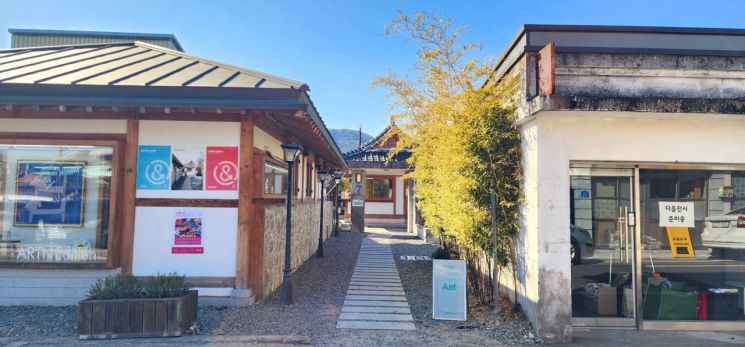 The old downtown area of Gwangyang is gaining attention as a new tourist attraction for travelers seeking retro vibes. The low walls lining the narrow alleys, shaped over many years side by side, offer the coziness and joy of walking through a maze. Photo by Gwangyang City
The old downtown of Gwangyang, where the city's history is deeply embedded with sites like the Gwangyang History and Culture Center and Inseori Park, is a place where memories of the past and modern sensibilities blend together. Rather than simply reproducing the old, it is quietly rebelling within a modern movement that seeks to discover and reinterpret new value in the old.
Once the center of Gwangyang, the old downtown declined over time, but the narrow alleys formed by low stone walls standing shoulder to shoulder for many years offer a cozy, maze-like experience. Beyond the neat stone walls under tiled roofs, trees such as poplars, camellias, persimmons, and even some exotic palm trees peek out, gazing at unfamiliar visitors with curious expressions.
At the heart of these tranquil alleys, where traditional Hanok houses with their own stories are densely packed, lies Inseori Park, an open, barrier-free complex cultural space. This area, where 14 old Hanok houses have been stylishly renovated, encompasses exhibition spaces, stays, cafes, and art shops. Last year, it was selected as one of Jeollanam-do's hottest spots for the MZ generation.
The Hanok stays, which preserve the original form as much as possible, include 'Dakyungdang' with a 100-year tradition, the cozy and sensuous 'Hoegyungdang,' and the modern, sophisticated 'Yerin's House.' Each accommodation exudes the antique warmth of traditional houses into the alleys, offering visitors a unique experience.
There are also various spaces here that stimulate artistic sensibilities. The art shop 'Art & Edition,' where you can appreciate and purchase art prints, and '01,' a former garage transformed into a multipurpose art space, together with the exhibition space 'Banchanggo,' serve as the faces of Inseori Park. 'Gapbao's House,' a once-ruined old house turned into a small art museum, showcases the moving artistic world of the artist 'Gapbao,' who expands genres across painting, crafts, sculpture, and more.
At 'Banchanggo,' an exhibition space that warmly preserves the atmosphere of an old grain warehouse, the exhibition 'Pleasant Spring, Paintings That Embrace Me, Art That Heals Me' runs until April 30. The exhibition features works by Kim Jonghak, a master of figurative painting, Spanish artist Eva Armisen, known for her depictions of happiness, as well as the humorous and innocent Lee Waljong and the cheerful Gapbao's objects.
Most importantly, Inseori Park serves as a hub in the cultural network connecting nearby modern cultural heritages such as Gwangyang Art Warehouse, Gwangyang History and Culture Center, and the Seoul National University Southern Experimental Forest Residence. In addition, the 'Art Road,' stretching from Inseori Park to Gwangyang Art Warehouse and Gwangyang History and Culture Center, is gradually revealing its colors and creating a new aura.
Gwangyang Art Warehouse is a complex cultural space created by regenerating a 60-year-old abandoned warehouse. It is divided into 'Media A,' which consists of a media video room and the Lee Kyungmo Archive, and 'Sogyo-dong B,' which serves as a communication space and cultural rest area. The interior exposes the wooden truss structure to enhance openness, and it connects with the nearby Jeonnam Provincial Museum of Art to expand visitor routes.
The Gwangyang History and Culture Center (Registered Cultural Heritage No. 444) was built in 1943 during the Japanese colonial period in a typical government office style, and after being rebuilt following a fire during the Korean War, a second floor was added. It now serves as a restored Gwangyang County Office. The center exhibits Gwangyang's history, its four main fortresses, Monk Doseon, Hwang Hyeon, the Righteous Army movement, and traditional architecture in a panoramic format, making it an ideal place to understand the region's background before a trip or to retrace your route afterward.
The Seoul National University Southern Experimental Forest Residence (Registered Cultural Heritage No. 223) was built as a staff residence within the Southern Experimental Forest of Keijo Imperial University during the Japanese colonial period. It retains the structure of a Japanese-style house and unique spatial composition, making it highly valuable from an architectural perspective.
Kim Miran, head of the Tourism Division, said, "In Gwangyang's old downtown, there are numerous complex cultural and artistic spaces that preserve the old atmosphere and stimulate retro sensibilities, including Gwangyang Art Warehouse and Inseori Park. In February, as we approach spring, I highly recommend a leisurely stroll through the old alleys to recharge your dulled senses and rediscover the hidden values of Gwangyang's old downtown."
© The Asia Business Daily(www.asiae.co.kr). All rights reserved.












