Effectiveness of Follow-Up Confirmation Texts and Other Measures
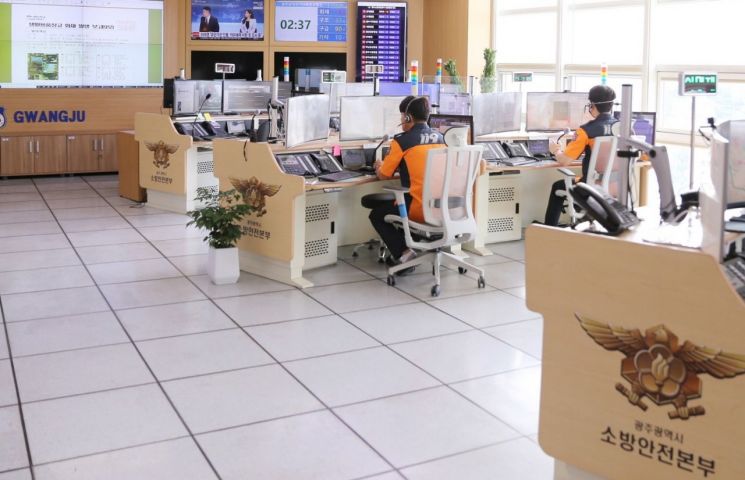 Gwangju Fire Safety Headquarters 119 Integrated Situation Room. Provided by Gwangju Fire Headquarters
Last year, the number of 119 emergency calls in Gwangju that resulted from no response or misdialing significantly decreased.
According to the Gwangju Fire and Safety Headquarters on the 19th, there were 289,597 emergency calls (an average of 791.2 per day) received in Gwangju last year. This marks a decrease of 30,374 calls (9.5%) compared to 319,971 calls the previous year.
Among these, the number of 119 calls due to no response or misdialing dropped by 11% (9,637 calls), from 87,505 in 2023 to 77,868 in 2024.
No response or misdialed calls occur when 119 is automatically dialed from a mobile phone in a pocket or when the emergency button is pressed on a phone without a USIM chip, among other situations.
Since last year, the Gwangju Fire and Safety Headquarters has been working to reduce unnecessary dispatches caused by no response or misdialed calls by sending follow-up confirmation text messages and checking for suspected emergencies through the 119 General Situation Room.
Na Hongwon, head of the 119 General Situation Room, requested, "We ask citizens to be especially careful to avoid non-urgent calls such as misdialed or no response calls, so that emergency responses in disaster situations are not delayed."
© The Asia Business Daily(www.asiae.co.kr). All rights reserved.












