Exports in February are showing a slight increase. The government expects the overall export growth to continue throughout February. However, due to significant uncertainties such as the imposition of tariffs by the United States, an export strategy meeting will be held this week to discuss measures to support companies affected by tariffs.
According to the government on the 16th, Choi Sang-mok, Acting Prime Minister and Minister of Strategy and Finance, will hold an export strategy meeting this week to discuss support for companies concerned about U.S. tariff damages and plans to diversify export items and regions.
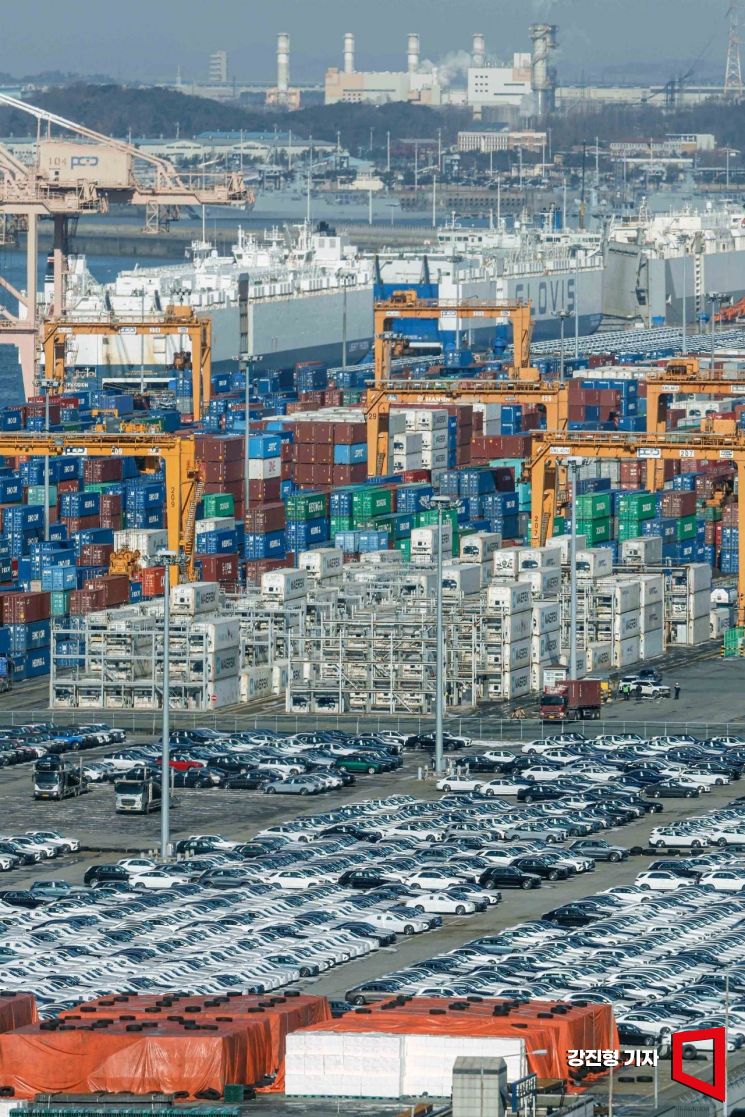 Export vehicles are waiting to be loaded at Pyeongtaek Port, Gyeonggi. February 13, 2025. Photo by Kang Jin-hyeong
At the government Seoul office on the 12th, during a joint meeting of the National Affairs Ministers, Economic Ministers, and Industrial Competitiveness Ministers, Acting Prime Minister Choi stated, "Uncertainties in the global trade environment have been intensifying recently," adding, "We will thoroughly inspect the impact on our industries and exports by sector and respond proactively and meticulously."
Recently, the Trump administration has been pressuring trade partners by consecutively announcing new trade measures, including imposing a 25% tariff on steel and aluminum and formalizing reciprocal tariffs.
Korean exports are showing a slight upward trend. According to the Korea Customs Service, export value from February 1 to 10 was $14.9 billion, an increase of 0.8% compared to the same period last year. The number of working days until the 10th this month was 7 days, 0.5 days more than the 6.5 days in the same period last year. Considering this, the average daily export value was $2.13 billion, a decrease of 6.4%.
An official from the Ministry of Trade, Industry and Energy explained, "Exports until the 10th recorded a slight increase compared to the same period last year," adding, "Although the trade balance is showing a deficit, this appears to be a temporary phenomenon caused by concentrated imports at the beginning of the month, and it is expected to improve toward the end of the month."
Among the top 10 major export items, six items increased, including semiconductors (1.8%), passenger cars (27.1%), wireless communication devices (19.2%), and precision instruments (3.7%). Exports of petroleum products (-22.3%) and automobile parts (-27.1%) decreased. By country, exports to China (4.5%), the European Union (EU, 11.7%), Vietnam (20.7%), and India (6.3%) increased, while exports to the United States (-8.6%) and Japan (-22.0%) decreased.
The trade balance recorded a deficit of $2.229 billion. Including this, the cumulative trade deficit from the beginning of this year to February 10 reached $4.089 billion.
The Ministry of Trade, Industry and Energy expects overall exports in February to show positive growth and a trade surplus. A ministry official said, "With semiconductor exports continuing their strong performance and automobiles expected to turn positive, a monthly export increase and surplus turnaround are anticipated for February," adding, "As the Trump administration’s tariff measures are being announced, we plan to maintain close communication and cooperation with the industry regarding these issues."
© The Asia Business Daily(www.asiae.co.kr). All rights reserved.












