Performance Verification of 7 GHz Band Base Station with Nokia
"We Will Focus on Technology Development for the 6G Era"
KT announced on the 16th that it has verified base station technology using extreme massive MIMO antennas in the 7 GHz band, one of the candidate frequency bands for 6G, in collaboration with Nokia.
Extreme massive MIMO technology refers to using a significantly larger number of antenna elements (the parts that emit radio waves) than 5G. It can increase transmission speed through methods such as ▲beamforming (a technology that concentrates signals in the desired direction to extend coverage) and ▲spatial multiplexing, which forms beams to multiple users simultaneously to transmit data.
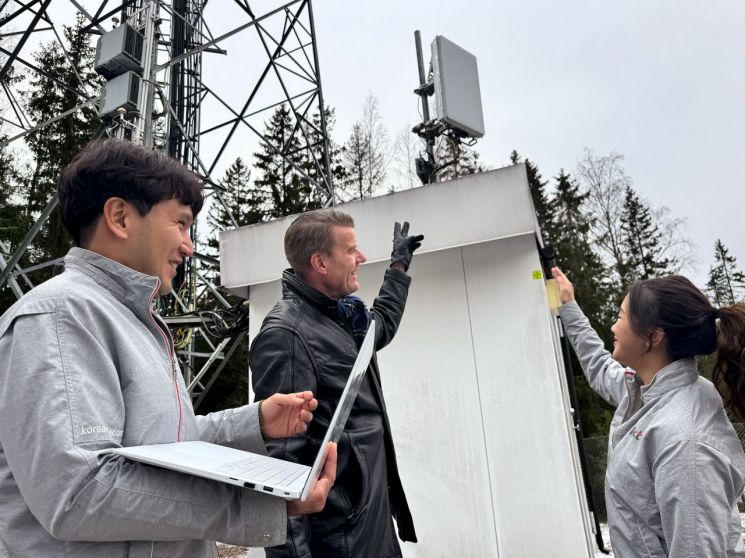 KT announced on the 16th that it has verified base station technology using extreme massive MIMO antennas in the 7 GHz band, one of the candidate frequency bands for 6G, in collaboration with Nokia. Photo by KT
KT confirmed that through extreme massive MIMO antennas, coverage comparable to 5G in the 3.5 GHz band is achievable even in the 7 GHz band. Frequency bands have the characteristic that as the band increases, the radio wave propagation distance decreases. This technology verification was conducted in Espoo, Finland, where Nokia’s headquarters are located.
Last year, KT built a measurement site in Gwanak-gu to verify the radio wave characteristics of the 7 GHz band in an urban environment in Korea. Although the 7 GHz band is expected to utilize a frequency range four times wider than existing 5G, the reception signal strength decreases because the frequency is twice as high compared to the 3.5 GHz band.
However, as the frequency increases, the wavelength shortens and the antenna length becomes smaller, allowing more antenna elements to be integrated into equipment of the same size. For example, compared to the existing 3.5 GHz band, antenna density can be increased fourfold (from 192 to 768 elements) in the 7 GHz band. This means the performance of the base station can be significantly enhanced.
KT plans to exhibit the results of this extreme massive MIMO base station technology verification in collaboration with Nokia at MWC 2025, held in Barcelona, Spain.
Lee Jong-sik, Executive Vice President and Head of KT’s Future Network Research Institute, said, “As the evolution of wireless communication generations involves utilizing different frequency bands, preparation is necessary to provide stable service. We will actively secure preemptive 6G element technologies to improve customer-perceived quality.”
© The Asia Business Daily(www.asiae.co.kr). All rights reserved.












