$1.78 Billion Net Outflow by Foreign Investors in January
$510 Million Net Outflow from Stock Market... Scale Decreases Due to Bargain Hunting
Won-Dollar Exchange Rate Falls, Domestic Political Impact Down, Trump Uncertainty Up
Last month, foreign investors continued to withdraw from the domestic securities market, marking the fifth consecutive month of net outflows. However, compared to December last year, when net outflows surged due to political uncertainty, the scale has decreased.
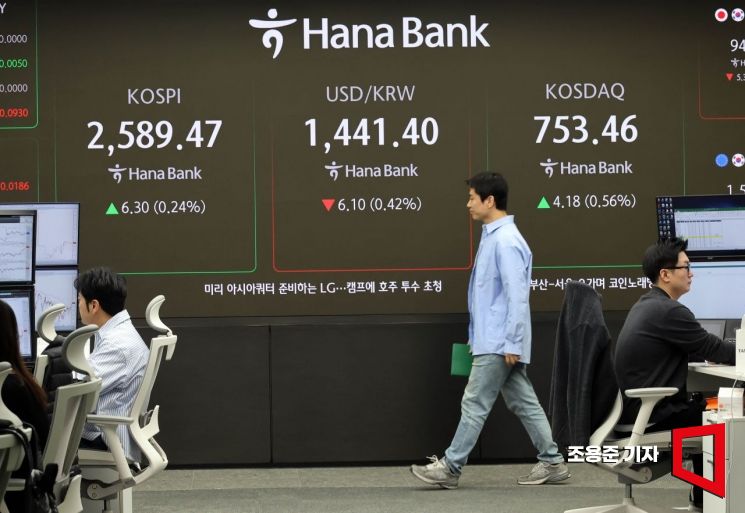 On the 14th, amid the removal of uncertainties regarding U.S. reciprocal tariffs, the New York stock market showed a simultaneous rise. The status board in the dealing room of Hana Bank in Jung-gu, Seoul, displayed the KOSPI index and the KRW/USD exchange rate. On that day, the KOSPI opened at 2,589.59, up 6.42 points (0.25%) from the previous session, while the KRW/USD exchange rate started at 1,441.30 won, down 6.20 won. 2025.2.14 Photo by Jo Yongjun
According to the "International Finance and Foreign Exchange Market Trends after January 2025" released by the Bank of Korea on the 14th, the net outflow of funds by foreigners from the domestic stock and bond markets in January amounted to $1.78 billion. The amount withdrawn from the stock market decreased compared to the previous month, reducing the overall net outflow. In December last year, the largest net outflow since March 2020, when concerns over COVID-19 were high, was recorded at $3.86 billion.
Foreigners withdrew $510 million from the domestic stock market last month, continuing net outflows for six consecutive months. However, the net outflow amount significantly decreased compared to $2.58 billion in the previous month. A Bank of Korea official explained, "Although net outflows continued due to concerns about the growth potential of domestic semiconductor companies and uncertainties in the economic policies of the new U.S. administration, the scale of net outflows significantly decreased due to the inflow of bargain hunting."
The net outflow from the bond market was recorded at $1.27 billion. This is slightly lower than December last year ($1.28 billion net outflow). It is analyzed that net outflows continued due to the maturity repayment of Monetary Stabilization Bonds and the continued low incentives for arbitrage trading.
The won-dollar exchange rate at the end of last month was 1,452.7 won, down from 1,472.5 won at the end of December last year. However, the month-on-month volatility of the won-dollar exchange rate in January was 0.41%, higher than 0.37% in the previous month. A Bank of Korea official said, "It fell due to the easing of domestic political uncertainty last month, but the decline was partially reduced due to concerns over the tariff policies of the new U.S. administration, resulting in this outcome."
© The Asia Business Daily(www.asiae.co.kr). All rights reserved.












