One-on-One Negotiations by Country...
Indication of Differentiated Tariff Rates
South Korea with FTA Also Expected to Be Affected by 'Non-Tariff Barriers'
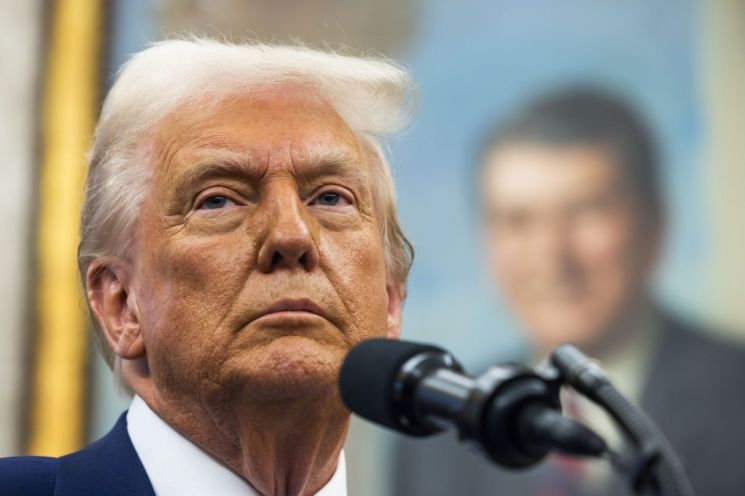 Donald Trump, President of the United States, is speaking in the Oval Office at the White House in Washington DC on the 12th (local time). On the 13th (local time), President Donald Trump officially announced the decision to impose "reciprocal tariffs" on countries around the world starting April 1, considering various tariff and non-tariff barriers. / UPI·Yonhap News
U.S. President Donald Trump officially announced on the 13th (local time) that he has decided to impose 'reciprocal tariffs' on countries worldwide, taking into account both tariff and non-tariff barriers. After one-on-one negotiations with each country, differential tariff rates are expected to be applied starting April 1. South Korea, which has a Free Trade Agreement (FTA) with the United States, is also likely to be subject to reciprocal tariffs.
Trump Signs Memorandum Deciding on Reciprocal Tariffs
President Trump signed a presidential memorandum on reciprocal tariffs at 1 p.m. in the White House Oval Office, stating, "I have decided to impose reciprocal tariffs for the sake of 'fairness,'" and added, "It will be fair to everyone, and no other country can complain."
Reciprocal tariffs mean that the United States imposes tariffs on goods from other countries at rates equivalent to the tariffs those countries apply to American products.
President Trump said that nominee for Secretary of Commerce, Howard Lutnick, will review both tariff and non-tariff barriers of other countries to determine the tariff rates. Lutnick indicated that "we will handle this on a one-on-one basis by country," suggesting that differentiated tariff rates will be applied after negotiations with each country.
Lutnick also stated, "The administration-level study on this issue will be completed by April 1," signaling that the practical application of reciprocal tariffs will begin after April 1.
According to the White House, the Department of Commerce and the U.S. Trade Representative (USTR) plan to submit a report to the president containing recommendations necessary to ensure reciprocal trade relationships on a country-by-country basis.
Focusing 'Like a Laser Beam' on Non-Tariff Barriers
A senior White House official explained in a pre-briefing that President Trump is focusing "like a laser beam" not only on tariffs imposed by trading partners but also on what are called non-monetary or non-tariff barriers in the reciprocal tariff policy.
The official added that the administration will set reciprocal tariffs tailored by country, considering "unfair and discriminatory taxes or extraterritorial taxes, including tariffs and value-added taxes imposed on U.S. products" by the counterpart countries.
Furthermore, the official said that costs imposed on American companies, workers, and consumers due to unfair or harmful measures, policies, or practices?including tariff barriers, non-tariff barriers, subsidies, and burdensome regulatory requirements?will also be evaluated.
Additionally, the official explained that currency policies artificially devaluing exchange rates and other practices deemed unfair by the USTR will also be factors considered when determining reciprocal tariffs.
Likely to Impose on South Korea as Well
Accordingly, it is expected that reciprocal tariffs will be imposed on South Korea, which has mostly eliminated tariffs through an FTA with the United States, citing reasons such as non-tariff barriers.
From the U.S. perspective, South Korea ranks among the 'top 10' trade partners with the largest trade deficits. South Korea ranks 8th after China, Mexico, Vietnam, Ireland, Germany, Taiwan, and Japan. According to the U.S. Department of Commerce’s International Trade Administration (ITA), South Korea’s trade surplus in goods with the U.S. reached $66 billion (95 trillion won) last year.
In fact, a senior U.S. official specifically mentioned South Korea, saying, "Whether it is strategic competitors like the Chinese Communist Party or allies like the European Union, Japan, or South Korea, every country is using us in different ways," and added that during the review process, the countries with the largest U.S. trade deficits and the most serious problems will be examined first.
President Trump, who has officially launched a 'tariff war,' previously began imposing an additional 10% tariff on China on the 4th, and on the 10th announced that starting from the 12th of next month, a 25% tariff will be imposed on steel and aluminum products without exceptions or exemptions.
© The Asia Business Daily(www.asiae.co.kr). All rights reserved.












