Four New Varieties Developed by Jeollanam-do Institute of Ocean and Fisheries Science
Haetbadi, Haepung, Haemodol, and More
Applications Accepted from Companies Until the 28th
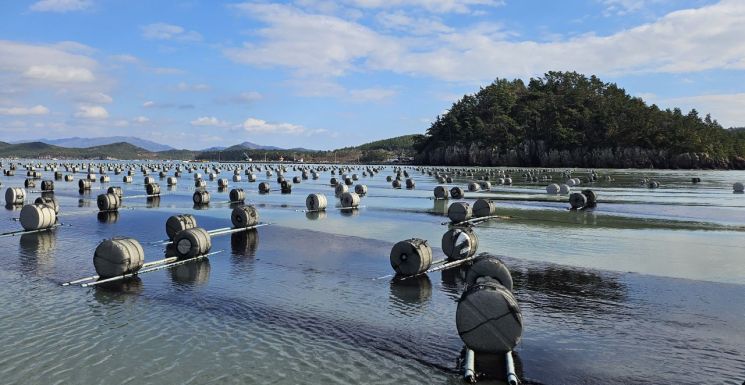 Jeonnam Province distributes newly developed new variety of seaweed seeds. Photo by Jeonnam Province
The Jeollanam-do Institute of Ocean and Fisheries Science is accepting applications for seed distribution until the 28th for the production of the 2026 Gim harvest, featuring four newly developed varieties: Haetbadi 1-ho, Haepung 1-ho, Haepung 2-ho, and Haemodol 1-ho.
Companies wishing to receive the seeds must submit an application form, a copy of the aquaculture seed production (Gim type) permit, and a copy of their ID either by visiting one of the institute’s nine branches in person or by mail or fax.
The Jeollanam-do Institute of Ocean and Fisheries Science has achieved the milestone of developing all three main domestic aquaculture Gim varieties as new breeds for the first time in Korea.
The two striped Gim varieties (Haepung 1-ho and Haepung 2-ho), commonly used for Gimbap, and the two plain stone Gim varieties (Haemodol 1-ho and Sinpung 1-ho), mainly used for seasoned Gim, are included, as well as Haetbadi 1-ho, the most expensive and flavorful Itbadidol Gim (also known as Gopchang Gim).
In particular, Jeollanam-do, which produces 78% of the nation’s raw Gim, has been leading the way in increasing fishermen’s income and driving the achievement of $1 billion in exports by continuously developing varieties such as Haepung 1-ho and Haemodol 1-ho, which have been distributed to fishermen since 2011, and Haetbadi 1-ho, which set the highest auction price for Gim last year.
The distribution price is 25,000 KRW per 1g of Gim free-living filament, and distribution is limited to Gim seed production companies in the Jeollanam-do region.
With 1g of free-living filament, it is possible to cultivate 5,000 shell filaments, and Gim aquaculture farmers can seed 33 frames, ultimately generating an income of 22 million KRW. This means that 1g of Gim seed creates 880 times its value in added profit.
Kim Chungnam, Director of the Jeollanam-do Institute of Ocean and Fisheries Science, said, “We will do our utmost to increase fishermen’s income by conducting research and development of varieties tailored to the characteristics of each region, in response to rapidly changing aquaculture environments.”
© The Asia Business Daily(www.asiae.co.kr). All rights reserved.












