Appellate Court Reaffirms End of Election Law Appeal on 26th
Lee to Lose Candidacy if Supreme Court Upholds First Trial Verdict
Prosecution Likely to Amend Indictment to Specify False Statements
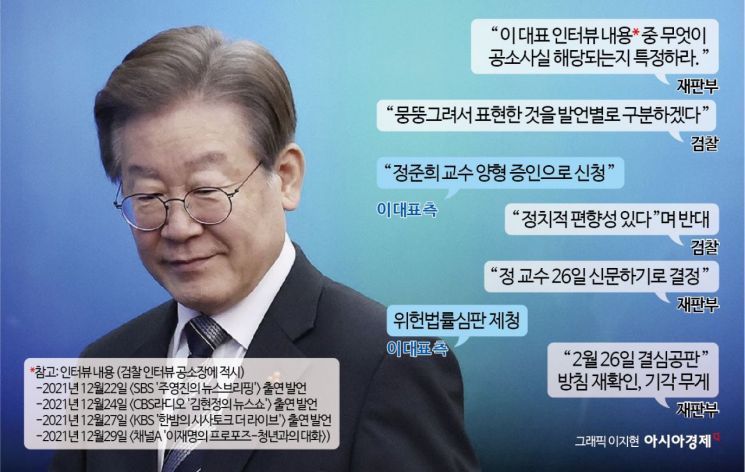
The appellate court handling the public official election law violation case against Lee Jae-myung, leader of the Democratic Party of Korea (Seoul High Court Criminal Division 6-2, presided by Chief Judge Choi Eun-jung), reaffirmed on the 12th during the third hearing that it plans to conclude the arguments on the 26th. This is the second time the court has stated this, having previously announced at the first appellate hearing, "Unless there are special circumstances, the decision hearing will be held on February 26." The court’s insistence on maintaining the existing schedule is interpreted as a sign of its intention to continue the trial. It also suggests that the court will not accept the constitutional review petition submitted by Lee’s side on the 5th.
Accordingly, the verdict for Lee’s second trial is likely to be delivered in March. The court announced that it will conduct one more witness examination on the 19th of this month, then hold a hearing on sentencing witnesses in the morning of the 26th, followed by the decision hearing in the afternoon. The decision hearing is the concluding procedure of the trial, during which the defendant’s final statement and the prosecution’s sentencing request take place. Typically, it takes about a month from the decision hearing to the verdict. In the first trial held last November, Lee was sentenced to one year in prison with a two-year probation. If the first trial’s verdict is finalized, Lee will be barred from running for public office.
Meanwhile, the court requested the prosecution to specify which statements made by Lee are related to false facts. The prosecution indicted Lee on the grounds that his remarks about the late Kim Moon-gi, former head of Development Project Division 1 at Seongnam Urban Development Corporation, made during appearances on four broadcasting stations, were false. The court asked the prosecution to specify the sentences that constitute false facts.
The first trial divided the charges related to Kim Moon-gi’s interview content into three categories: ① did not know while serving as mayor, ② did not play golf together, and ③ learned after indictment. The court requested the prosecution to specify which statements correspond to each category. The prosecution responded regarding which of the four interviews corresponded to ①~③, but the court pointed out, "The indictment is written in a list format, so it may not be clear what is subject to judgment." Although the indictment contains all the interview content, the court suggested that it may be necessary to amend the indictment itself to accurately specify the problematic expressions. The court stated, "The facts of the indictment must be specified within the indictment itself." The prosecution replied to the court’s comment, "We will review amending the indictment to separate the broadly expressed statements by each remark."
The court granted Lee’s side the opportunity to present testimony from sentencing witnesses. Lee’s side applied to call Professor Jung Joon-hee of Hanyang University, who participated in the '100-minute debate.' Professor Jung is expected to testify that Lee’s remarks were made spontaneously during a live broadcast and thus had minimal impact on the election. The prosecution opposed calling Professor Jung as a witness, arguing that he is politically biased, but the court rejected this and decided to question Professor Jung at 10:30 a.m. on the 26th.
© The Asia Business Daily(www.asiae.co.kr). All rights reserved.